If someone is in immediate danger, call 999 and follow your service’s emergency procedure. If you or someone you support is struggling, Samaritans are free to call any time on 116 123.
What is a ligature point?
In health and social care, a ligature is anything that could be used to cause harm by tying or tightening. A ligature point, also called a ligature anchor point, is anything a ligature could be attached to.
Some ligature points are obvious and easy to reach. Others are less obvious, low down, or only appear over time through wear and tear, damage or new items being brought in. That is why ligature points need regular review, not a one-off check.
What current guidance says
In 2023 the Mental Health and Learning Disability Nurse Directors Forum published guidance on reducing harm from ligatures, developed with experts by experience and the Care Quality Commission (CQC). It was written for mental health wards and wards for people with a learning disability, but its principles are a useful starting point for any service supporting people who may be at risk of self-harm. It looks at five areas: therapeutic engagement, the built environment, staffing and skills, technology and procurement.
Key messages include:
- Environments change. Items are brought in, removed or damaged, so risk assessments need to be reviewed continually.
- Low-lying ligature points should not be judged as low risk and should be removed where possible.
- Safety is balanced with dignity. The aim is a care environment that is as safe as possible while keeping people’s privacy and dignity and supporting their recovery.
- Relationships matter. The guidance puts therapeutic engagement first, alongside individual risk assessment, rather than relying on tools that try to predict risk.
Using the checklist
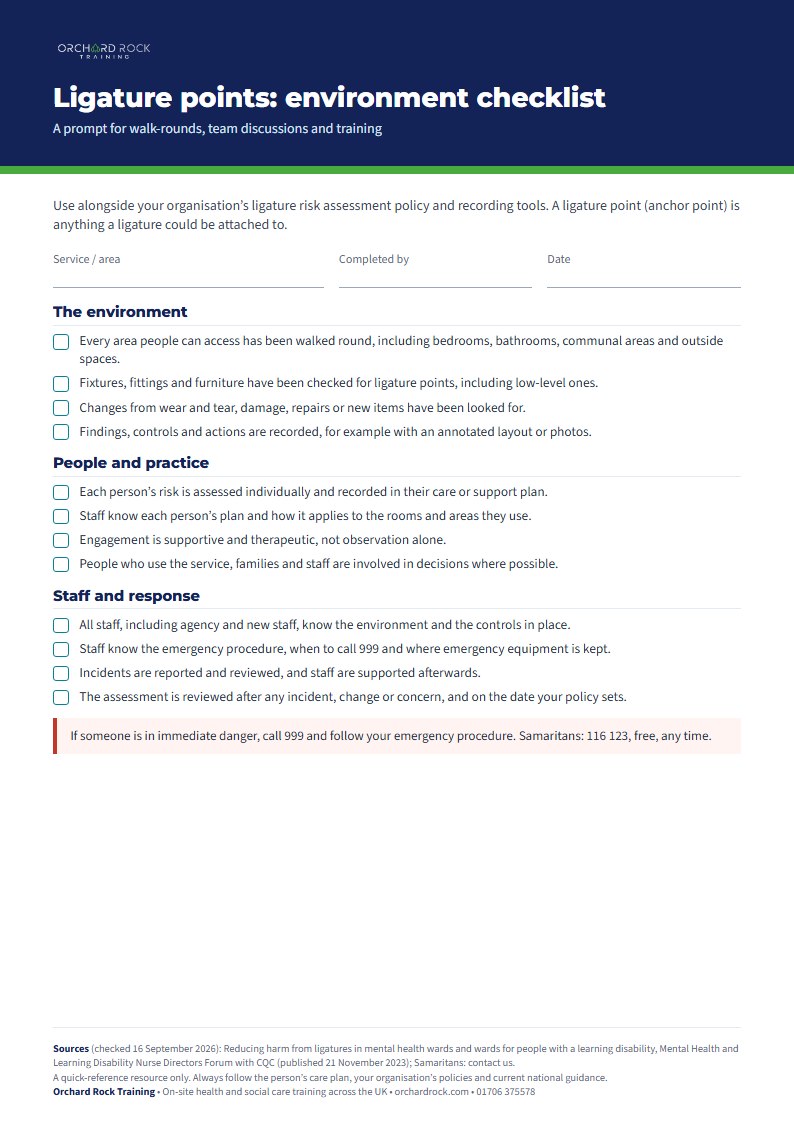
The checklist is a prompt for your team. It doesn’t replace your organisation’s ligature risk assessment policy or recording tools. Use it to:
- prepare for an environmental walk-round
- check that new and agency staff know the environment and the controls in place
- review arrangements after changes to the building, furniture or the people you support
- start a conversation in supervision or a team meeting
The environment
- Every area people can access has been walked round, including bedrooms, bathrooms, communal areas and outside spaces.
- Fixtures, fittings and furniture have been checked for ligature points, including low-level ones.
- Changes from wear and tear, damage, repairs or new items have been looked for.
- Findings, controls and actions are recorded, for example with an annotated layout or photos.
People and practice
- Each person’s risk is assessed individually and recorded in their care or support plan.
- Staff know each person’s plan and how it applies to the rooms and areas they use.
- Engagement is supportive and therapeutic, not observation alone.
- People who use the service, families and staff are involved in decisions where possible.
Staff and response
- All staff, including agency and new staff, know the environment and the controls in place.
- Staff know the emergency procedure, when to call 999 and where emergency equipment is kept.
- Incidents are reported and reviewed, and staff are supported afterwards.
- The assessment is reviewed after any incident, change or concern, and on the date your policy sets.
If you are worried about someone
If someone is in immediate danger, call 999 and follow your service’s emergency procedure. Talk to the person, stay with them if it is safe to do so, and tell the person in charge. Samaritans are free to call any time on 116 123, for the people you support and for staff.
Download and printGuide and checklist (PDF, 1 page). Free to use in your service.
Download the PDFThis is a quick-reference resource. Always follow the person’s care plan, your organisation’s policies and procedures, and current national guidance.
Sources (checked 16 September 2026): Reducing harm from ligatures in mental health wards and wards for people with a learning disability, Mental Health and Learning Disability Nurse Directors Forum with CQC (published 21 November 2023); Samaritans: contact us.