The short version
- No regulator approves training providers. HSE stopped approving first aid training in 2013, and CQC does not endorse outside organisations.
- Ask who the trainers are and how they are qualified, how the provider checks its own quality, and how big the groups will be.
- If you want to claim funding, check the official list of quality-assured courses before you book.
- After the course, check the learning in supervision. Training should show in how people work.
Nobody approves training providers for you
Since 1 October 2013, HSE no longer approves first aid training, qualifications or training organisations. It also says it cannot advise on the quality of individual training providers.
CQC does not approve them either. Its terms and conditions say it does not endorse, approve or recommend the products or services of any outside organisation. So a provider that calls itself “CQC approved” is claiming something CQC does not do.
The checks therefore fall to you. Fortunately, HSE and adult social care guidance both set out what to look for.
Questions to ask any provider
Sector guidance on choosing a learning provider asks whether the trainers are suitably qualified with relevant experience, whether the content follows up-to-date legislation, guidance and best practice, and whether learners are assessed fairly, accurately and reliably. It says you should be able to answer yes to all of its questions. Alongside those, we would ask:
- Who will deliver our course, and what is their background in care?
- Will the course be tailored to our setting and the people we support?
- How do you check your own quality, and what do you do with feedback?
- How big will the group be for the practical parts?
- What will each delegate receive, and when should they refresh?
- Can you train at our premises, with our own equipment?

First aid: HSE’s five checks
For first aid, HSE’s guide Selecting a first-aid training provider (GEIS3, January 2024) lists five things to check: the qualifications of trainers and assessors, monitoring and quality assurance, teaching and standards of first aid practice, syllabus content, and certification.
Trainers
A current First Aid at Work certificate, or registration as a doctor, nurse or paramedic, plus knowledge and competence in training or assessing.
Quality assurance
A documented plan, a named person responsible for it, and an assessment of each trainer’s skills at least once a year.
Feedback and complaints
A course evaluation that includes feedback from learners, and a documented complaints procedure.
Group size
HSE warns that groups of more than 12 make it harder to meet each candidate’s needs and to assess them properly, unless extra trainers are provided.
Course length
EFAW: at least six hours over a minimum of one day. FAW: at least 18 hours over a minimum of three days.
Certificates
The certificate should name the training organisation and the qualification, and confirm that it is valid for three years.
HSE adds that you do not have to write down the checks you make, but it may be useful to keep a record.
On-site, online or blended?
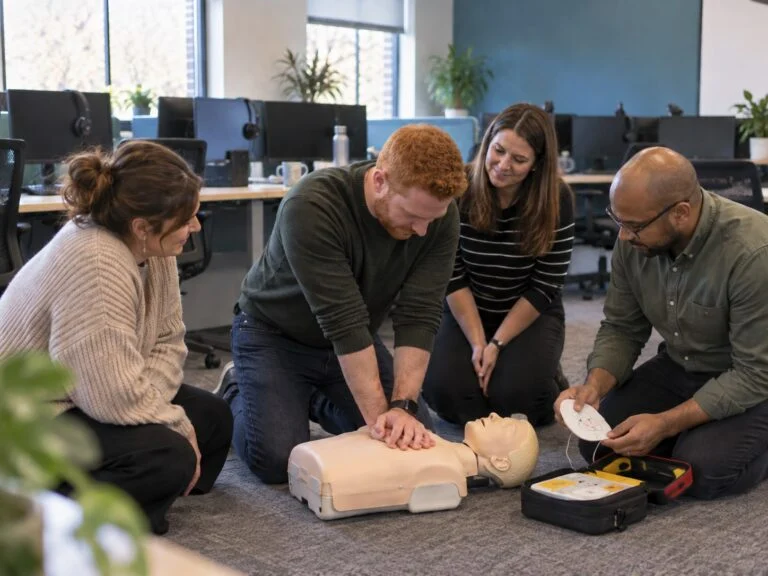
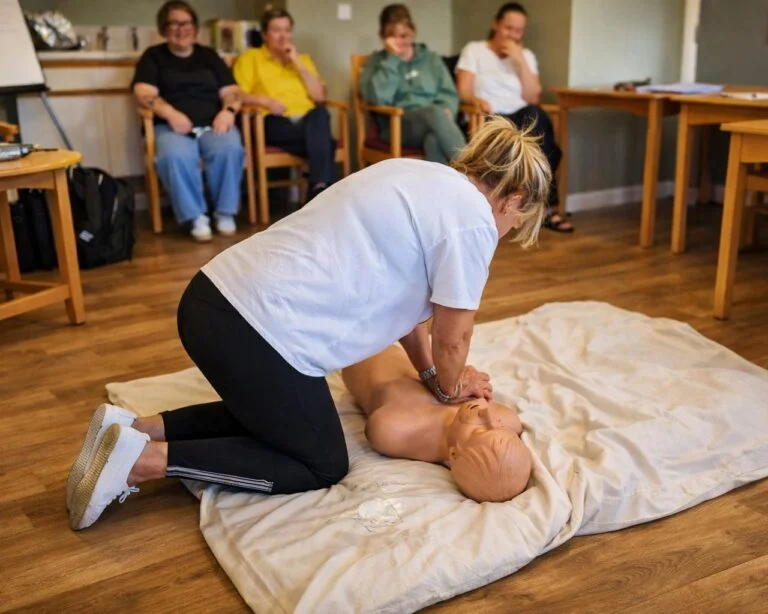
For skills that people can only learn by doing, the practical part matters most. HSE strongly recommends that the practical elements of first aid courses are assessed by direct observation. For manual handling, HSE says training should be tailored to the tasks people carry out and should include practical work, so that the trainer can spot anything unsafe and put it right.
On-site training helps here, because staff learn with your own equipment, in your own building. Sector guidance makes the same point in general terms: training should relate to the setting and to the needs of the people who access care and support.
For theory subjects, a live online session can work well. Quality standards for care learning apply whatever the delivery method, whether face-to-face, online or blended.
Funding and the quality-assured list
In autumn 2024, the Department of Health and Social Care launched the Quality Assured Care Learning Service. It reviews individual courses and qualifications against nine quality standards, and publishes a list of approved courses that is updated every fortnight.
The service only covers courses funded through the Learning and Development Support Scheme. For 2026 to 2027, employers can claim back eligible courses from any training provider, but future claims may be limited to quality-assured providers. So if you plan to claim funding, check the current rules and the list before you book.
Learning disability and autism training has its own route. The Oliver McGowan code of practice says providers must source training that meets the expected standards set out in the code, and there is a separate published list of quality-assured Oliver McGowan training providers.
Worth remembering
The best evidence that training worked is not the certificate. It is what changes in how your team works the following week.
After the course: check it worked
Sector guidance says it is vital to make time to evaluate training afterwards, on an individual basis during supervision. CQC’s guidance says training should be monitored, with action taken quickly when requirements are not being met. For medicines, NICE asks for a yearly review of each person’s knowledge, skills and competency.
- ask what has changed in someone’s practice, not only whether they enjoyed the day
- observe the skill: a transfer, a medicines round, a handover
- put the next refresher date on the training matrix straight away
How we answer those questions
As a training provider ourselves, here are our own answers:
- we have delivered on-site training since 2006, at your premises, anywhere in the UK
- our clinical courses are taught by registered nurses
- we are a Qualsafe registered centre for first aid
- practical groups are capped at 12, and other groups at 15
- we tailor courses to your setting, and every delegate receives a certificate
- we are rated 4.9 out of 5 from more than 1,800 Google reviews
Ask us anything on this list before you book. We would rather you checked.
Free resources
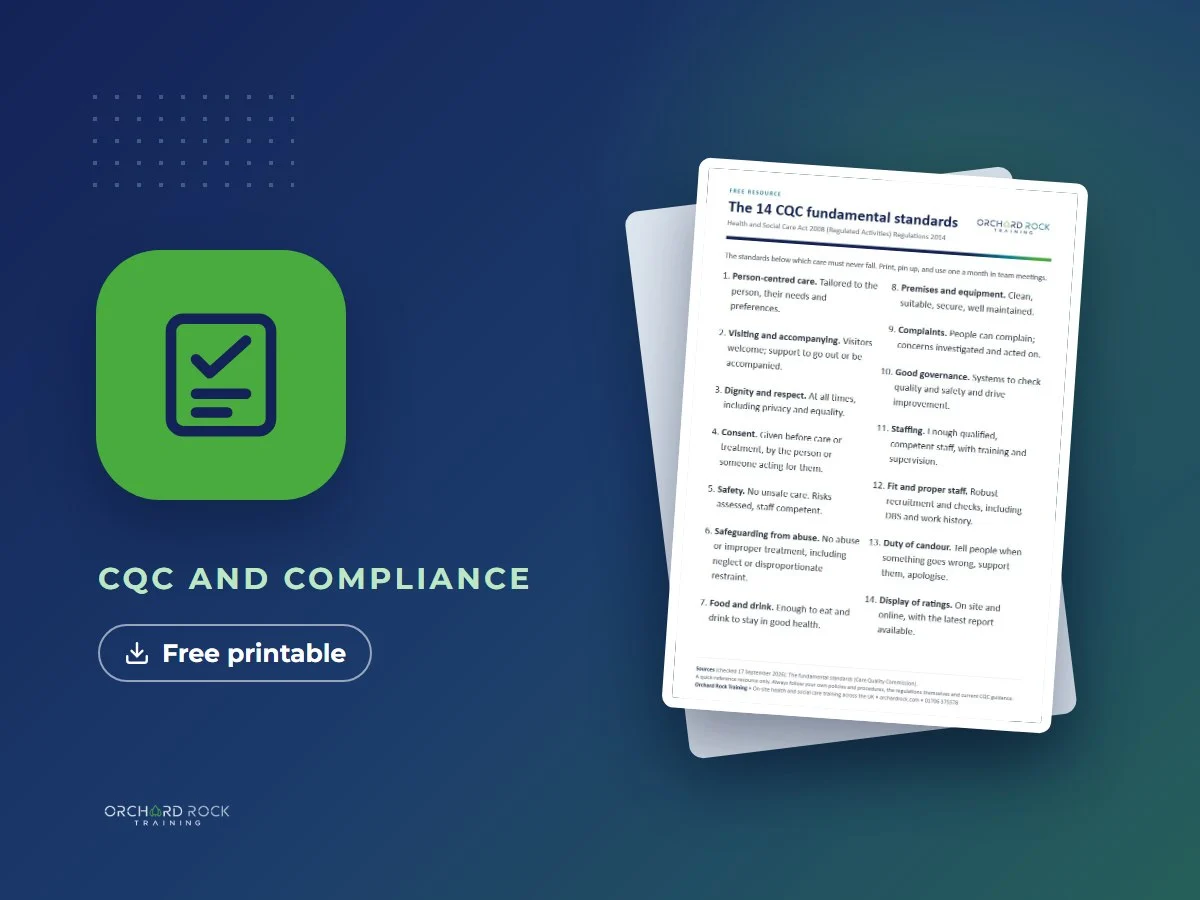
Download, print and share these with your team.
Sources: HSE, First aid: what employers need to do, Selecting a first-aid training provider (GEIS3) and Manual handling at work: training; CQC, Terms and conditions and Regulation 18: Staffing; GOV.UK, The Oliver McGowan code of practice; NICE, Managing medicines in care homes (SC1). Correct as of 21 October 2026.