The short version
- There is no fixed number in law. Your first aid needs assessment decides.
- HSE’s care home guidance treats most care homes as medium risk: with 5 to 50 employees, at least one first aider trained in EFAW or FAW; with more than 50, one FAW first aider for every 50.
- Those numbers apply at all times people are at work, so plan per shift and cover absences.
- The law does not cover residents, but HSE strongly encourages you to include them, for example someone at serious risk of choking.
The Health and Safety (First-Aid) Regulations 1981 do not give a number. Instead, they ask every employer to provide “such number of suitable persons as is adequate and appropriate in the circumstances” to give first aid to employees who are injured or become ill at work.
HSE puts it plainly: “There are no hard and fast rules on exact numbers.” So the number comes from your first aid needs assessment.
Start with the needs assessment
HSE lists what the assessment should look at. For a care home, these matter most:
- the nature of the work you do
- the work patterns of your staff, including nights and weekends
- holidays and other absences of your first aiders and appointed persons
- first aid for people who are not employees, such as residents and visitors
HSE’s numbers for care homes
HSE’s general first aid leaflet does not mention care homes. However, HSE’s guidance Health and safety in care homes (HSG220, published in 2014 and still available from HSE) describes a care home as medium-risk premises, and suggests these ratios:
- Fewer than 5 employees: at least one appointed person
- 5 to 50 employees: at least one first aider trained in EFAW or FAW, depending on the type of injuries that might occur
- More than 50 employees: at least one first aider trained in FAW for every 50 employed, or part thereof
Those are the same numbers as the higher-hazard row in HSE’s general guidance, not the row for offices and shops. In other words, a care home should not plan its first aid like an office.
Count per shift, not per payroll
HSE’s suggested numbers are what you need available “at all times people are at work”. HSE adds that shift work may mean more first aid personnel than its table suggests, and that you need extra provision to cover absences.
For a care home that runs day and night shifts, that means a trained first aider on every shift, plus enough people trained to cover annual leave and sickness. One name on the training matrix is rarely enough.
The numbers are for every hour people are at work, not just the day shift.
Residents and visitors
The 1981 Regulations only cover employees. However, HSE’s health and social care guidance says it “strongly encourages employers to consider non-employees”, such as users of care services, when carrying out the assessment, and to make provision for them.
HSE gives a care home example: a resident known to be at serious risk of choking, where training in emergency techniques may be appropriate. Its guidance on the regulations adds that covering non-employees may mean training first aiders above the legal minimum, so that they can act competently.
Appointed person or first aider?
An appointed person takes charge of the first aid arrangements and calls the emergency services. HSE says they need no formal training, but they must be available at all times people are at work. Most care homes employ more than five people, so HSE’s numbers point to a trained first aider rather than an appointed person alone.
Which first aid course?
Emergency First Aid at Work (EFAW)
- at least six hours of training over a minimum of one day
- emergency first aid: an unconscious casualty, CPR, choking, bleeding and shock
- HSE’s care home numbers ask for EFAW or FAW with 5 to 50 employees, depending on the injuries that might occur
First Aid at Work (FAW)
- at least 18 hours of training over a minimum of three days
- everything in EFAW, plus injuries and illness in more depth
- with more than 50 employees, at least one FAW first aider for every 50
Sector training guidance for adult social care adds basic life support for care workers: at least once a year, with first aid refreshed every three years. HSE says first aid certificates last three years and strongly recommends a yearly refresher in between.
CQC’s guidance also asks providers to have arrangements to act if there is a clinical or medical emergency, and it names first aid training for people working in adult social care.
Quick answers
- A home with 4 employees: at least one appointed person, always available. You can still choose EFAW, and residents’ needs may call for it.
- A home with 30 employees on days and nights: at least one EFAW or FAW first aider on every shift, plus cover for leave.
- A home with 80 employees: at least two FAW first aiders by HSE’s numbers, one for every 50 or part of 50, and in practice more, so that every shift is covered.
- The rest of the team: basic life support every year, as sector guidance recommends.
- A resident at serious risk of choking: train the staff who support them in the emergency techniques they need.
For workplaces other than care, see our guide Which first aid course does your workplace need?
Book the training
- Emergency First Aid at Work (EFAW) (full day)
- First Aid at Work (FAW) (3 days)
- Basic Life Support (BLS) (half day): the yearly refresher for the wider team
- First Aid Awareness (half day)
- Dysphagia and IDDSI (half day): swallowing difficulties and safer eating and drinking
- Anaphylaxis (half day)
Free resources
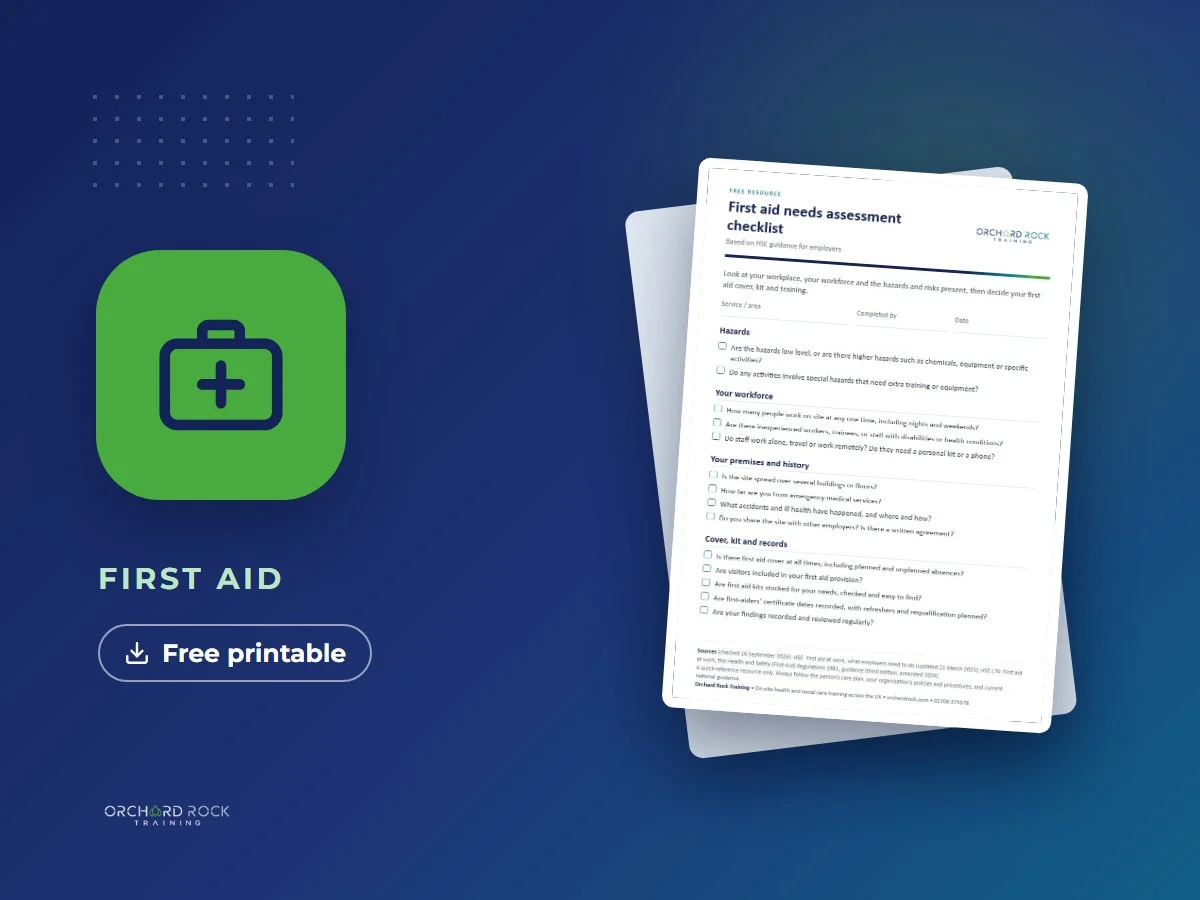
Download, print and share these with your team.
Sources: legislation.gov.uk, Health and Safety (First-Aid) Regulations 1981, regulation 3; HSE, First aid: what employers need to do, First aid frequently asked questions, First aid at work: your questions answered (INDG214), Health and safety in care homes (HSG220), Health and social care: frequently asked questions, First aid at work: guidance on regulations (L74) and Selecting a first-aid training provider (GEIS3); CQC, Regulation 12: Safe care and treatment and Regulation 18: Staffing. Correct as of 21 October 2026.