
Dysphagia & IDDSI
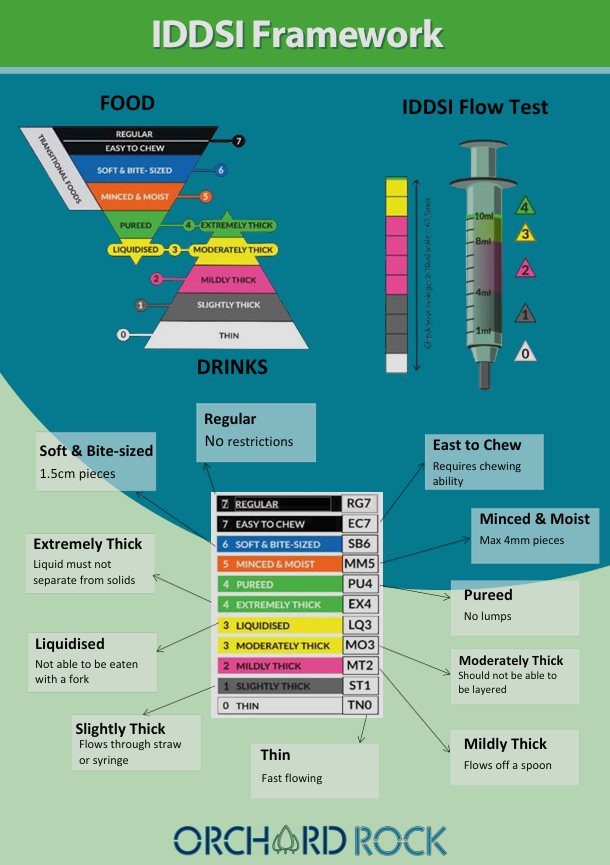
Dysphagia and IDDSI training helps your team support people living with dysphagia safely and effectively. It follows the IDDSI framework, current NICE guidance and UK legislation. Delivered on-site by our experienced trainers, with practical work wherever the subject allows.
About the course
Support people living with dysphagia safely
By the end of the course, delegates will:
- Recognise dysphagia and its common causes, including neurological and structural conditions
- Identify a resident’s prescribed IDDSI Level for food and drink, and never alter food prepared by the chef
- Provide appropriate positioning, environment, utensils and support at mealtimes
- Use the IDDSI Flow Test and Food Tests correctly to confirm food and drink consistency
- Use thickening agents safely, in line with the resident’s prescription
- Respect informed choice within the law, including the Mental Capacity Act 2005 and Equality Act 2010
- Carry out risk assessments and manage the risk from visitors bringing in food
- Recognise the signs of choking and respond with back blows, abdominal thrusts and CPR as needed
What you’ll cover
Full course content
Everything the course covers, exactly as our trainers deliver it:
Understanding Dysphagia
- What is dysphagia?
- How common is it?
- Key points
Neurological Causes of Dysphagia
- Stroke
- Parkinson’s disease
- Multiple sclerosis (MS)
- Amyotrophic lateral sclerosis (ALS)
- Cerebral palsy
- Dementia
- Head injury
- Muscular dystrophy
Other Causes of Dysphagia
- Head and neck cancers
- Oesophageal disorders
- Gastroesophageal reflux disease (GERD)
- Scleroderma
- Medication
- Radiation therapy
- Infections
- Developmental or learning disabilities
- Foreign objects
- Pharyngeal pouch
Symptoms & Other Concerns for Eating and Drinking
- Physical symptoms
- Impact on mental health and wellbeing
- Health, state and alertness
- Perception, communication and wider needs
Person-Centred Care & Visitors
- Health, communication and environment
- Personal beliefs, culture and preferences
- Managing the risk (visitors and food)
- Respecting choice and capacity
Mealtime Support
- Positioning
- Creating the right environment
- Utensils
- Preparation
- During the meal
The IDDSI Framework
- Origin and purpose
- Worldwide and UK adoption
IDDSI Drink Levels
- Level 0 — Thin
- Level 1 — Slightly Thick
- Level 2 — Mildly Thick
- Level 3 — Moderately Thick (Drink)
- Level 4 — Extremely Thick (Drink)
IDDSI Food Levels
- Level 3 — Liquidised (Food)
- Level 4 — Pureed (Food)
- Level 5 — Minced & Moist
- Level 6 — Soft & Bitesize
- Level 7 — Regular
- Level 7 — Easy to Chew
Transitional Foods, Medication & Thickening Agents
- Transitional foods (Levels 5-7)
- Medication
- Using thickening agents safely
- Key points
Testing Food and Drink Consistency
- The drinks flow test
- Fork drip test
- Spoon tilt test
- Minced & Moist test
- Fork pressure test
- Regular / Easy to Chew tests
Risk Assessments and Risk Assessing Choice
- Symptoms risk assessment
- Risk assessing choice
- Key points
Choking — Recognition, First Aid & Escalation
- Recognising the signs
- First aid — what to remember
- Back blows
- Abdominal thrusts
- Unconscious casualty — adult CPR
Roles, Responsibilities & Food Presentation
- Employer’s responsibilities
- All employees’ responsibilities
- Chef’s responsibilities
- Presenting blended food well
Keep exploring
Related specialist courses
These subjects sit naturally alongside this course — and we can combine courses into one visit.
Good to know
Frequently asked questions
Where is the training delivered?
All of our training is delivered on-site at your service, anywhere in the UK — we come to you, so there are no travel costs or venue hire for your team.
How long is the Dysphagia & IDDSI course?
It runs as a half day – 3 hours course, delivered in one visit unless stated otherwise.
How many delegates can attend?
Up to 12 delegates per session — we keep practical groups smaller so everyone gets hands-on time.
Is there a practical element?
Yes — delegates practise the techniques hands-on during the course, guided by the trainer.
Do delegates receive a certificate?
Yes — every delegate receives a certificate on completion. Certificates are valid for 2 years, so plan refresher training before they expire.
How much does the course cost?
We price every course on application, based on your dates, location and delegate numbers. Use the contact buttons below — we reply quickly with a quote.
Can we combine courses into one visit?
Yes. Many clients build a full training day from shorter courses, and we can deliver several subjects in one visit — just tell us what your team needs.
Do you only train care providers?
No. This course suits care & nursing homes, home care & domiciliary, supported living, day services, hospices. If your sector isn’t listed, ask — we’ll tailor the course to your setting.
Book this course
We bring Dysphagia & IDDSI training to your service
Delivered on-site at your service, nationwide, with pricing on application. Tell us your dates and delegate numbers and we’ll reply quickly with a quote.
Part of our specialist training range. Also explore behaviour management training and mental health training.