Which law applies?
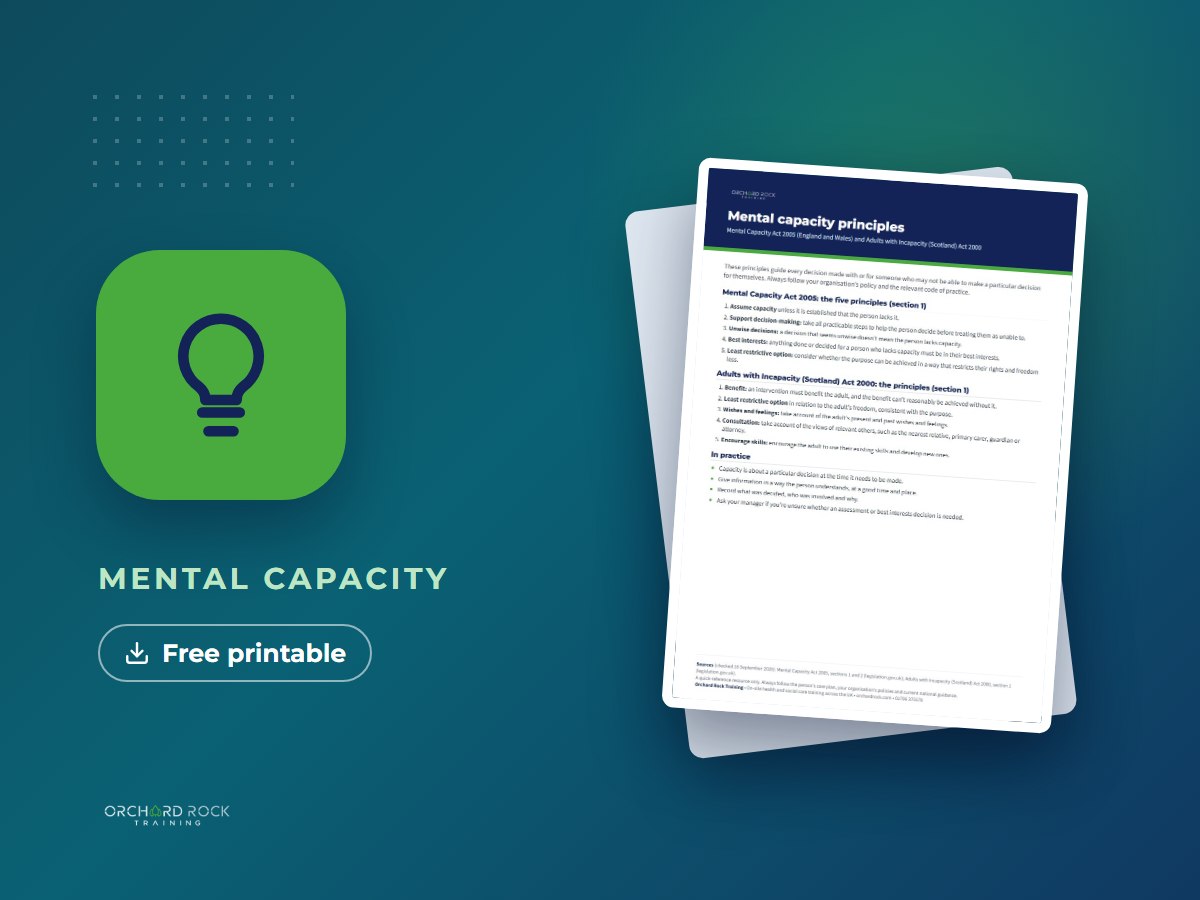
The Mental Capacity Act 2005 applies in England and Wales. In Scotland, the Adults with Incapacity (Scotland) Act 2000 applies. Both set out principles that must guide decisions and actions for people who may not be able to make a particular decision for themselves.
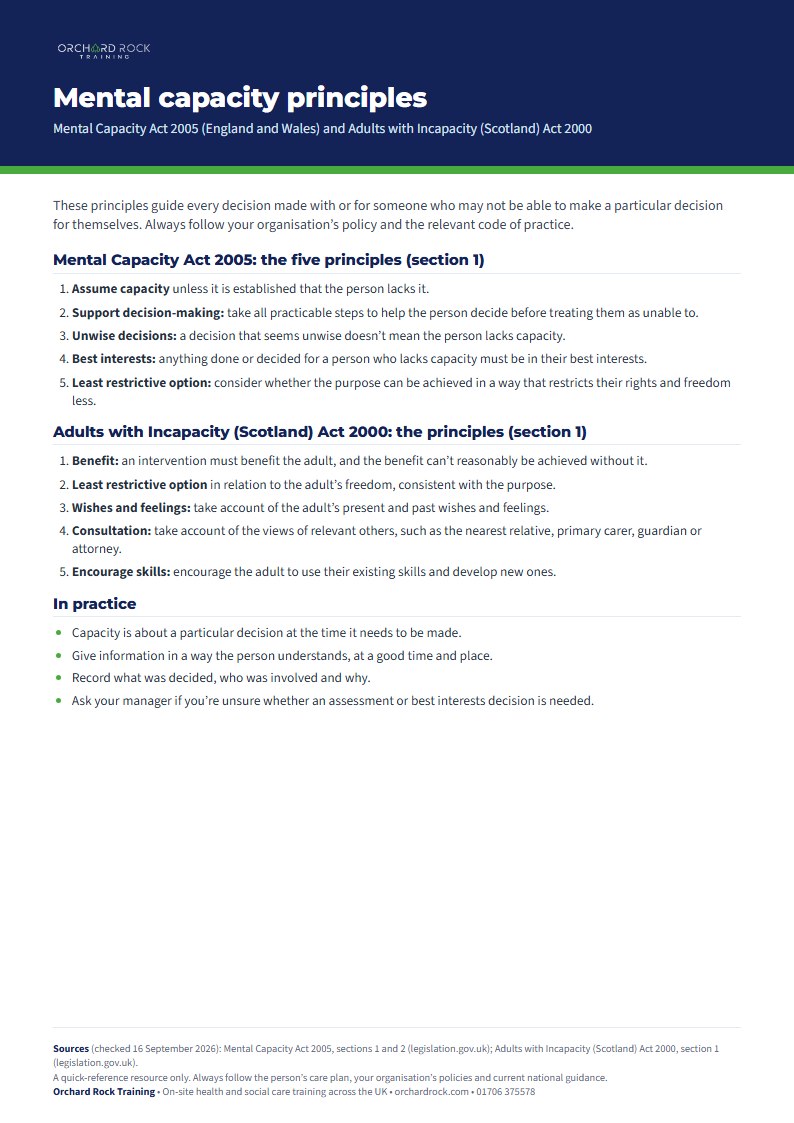
The five Mental Capacity Act principles
Section 1 of the Mental Capacity Act 2005 sets out five principles. In plain English:
- Assume capacity. A person must be assumed to have capacity unless it is established that they lack it.
- Support decision-making. A person isn’t treated as unable to make a decision until all practicable steps to help them have been taken without success.
- Unwise decisions. A person isn’t treated as unable to make a decision just because the decision seems unwise.
- Best interests. Anything done or decided for a person who lacks capacity must be done in their best interests.
- Least restrictive option. Before acting or deciding, consider whether the purpose can be achieved just as well in a way that restricts the person’s rights and freedom of action less.
Capacity is judged in relation to a particular decision at the time it needs to be made (section 2 of the Act), so someone may be able to make some decisions but not others.
The Adults with Incapacity (Scotland) Act principles
Section 1 of the Adults with Incapacity (Scotland) Act 2000 sets out the principles for any intervention in an adult’s affairs under the Act. In plain English:
- Benefit. An intervention must benefit the adult, and that benefit can’t reasonably be achieved without it.
- Least restrictive option. Any intervention must be the least restrictive option in relation to the adult’s freedom, consistent with its purpose.
- The adult’s wishes and feelings. Take account of the adult’s present and past wishes and feelings, as far as they can be found out.
- Consultation with others. Take account of the views of relevant others, such as the adult’s nearest relative, primary carer, guardian or attorney, where this is reasonable and practicable.
- Encourage the adult’s skills. Guardians, attorneys and managers must encourage the adult to use whatever skills they have, and to develop new skills.
Putting the principles into practice
- Start from the position that the person can make the decision.
- Give information in a way the person understands, at a good time and place, using any communication aids they use.
- Respect decisions you disagree with, and raise any concerns about risk in line with your organisation’s policy.
- Record what was decided, who was involved and why.
- Ask your manager if you’re unsure whether a capacity assessment or best interests decision is needed.
Download and printSummary (PDF, 1 page). Free to use in your service.
This is a quick-reference resource. Always follow the person’s care plan, your organisation’s policies and procedures, and current national guidance.
Sources (checked 16 September 2026): Mental Capacity Act 2005, sections 1 and 2 (legislation.gov.uk); Adults with Incapacity (Scotland) Act 2000, section 1 (legislation.gov.uk).