8:15: desks to the wall
Care homes have lounges. Contact centres have carpet tiles, and a lot of chairs on wheels.
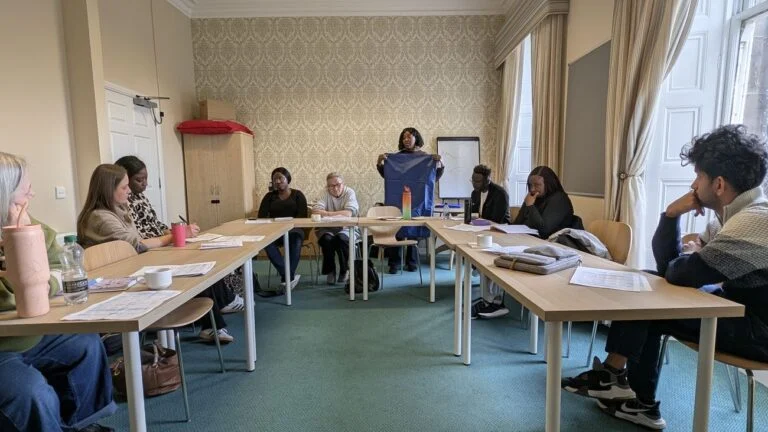
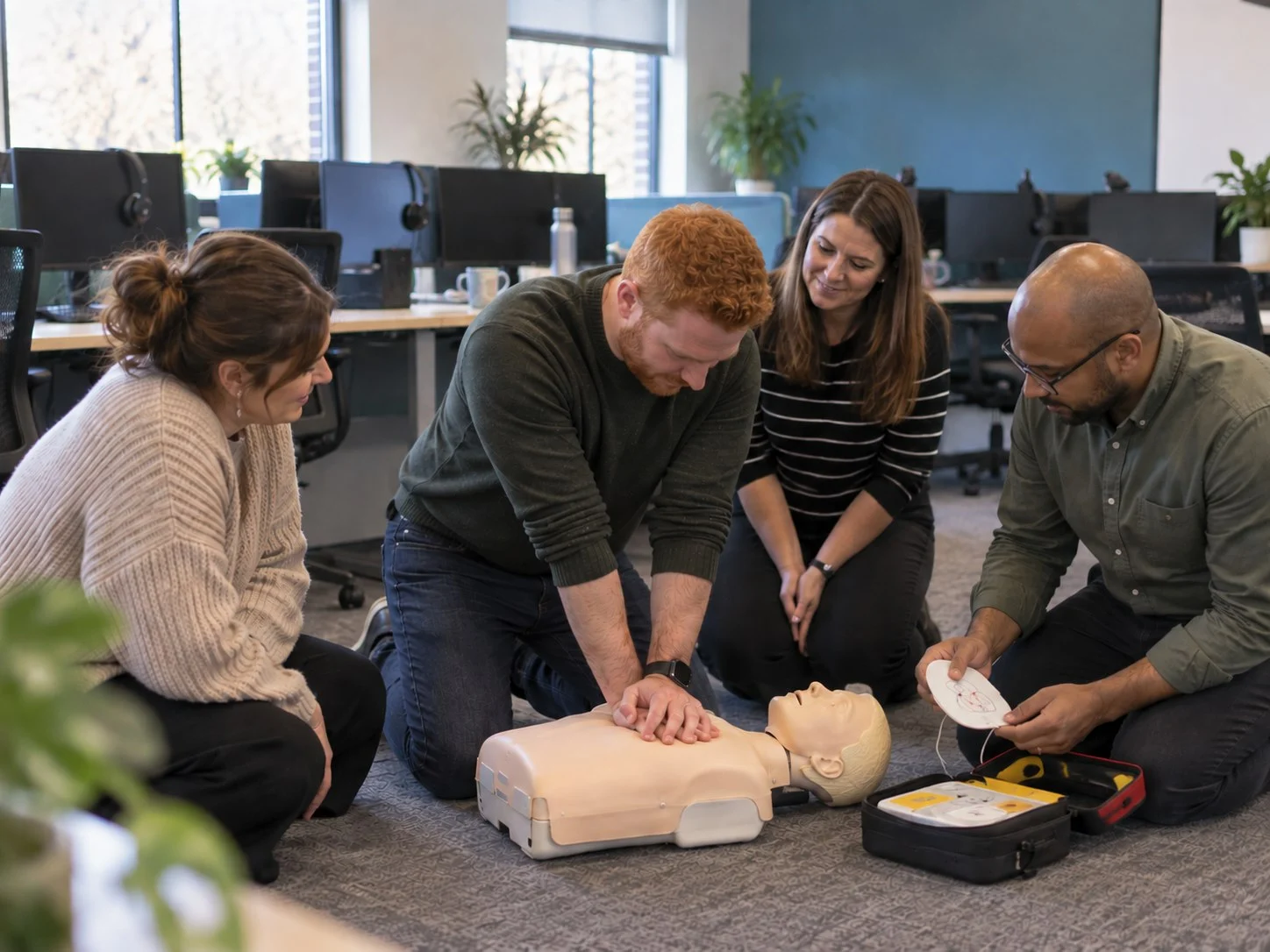
Today was Emergency First Aid at Work for twelve people who spend their day on the phones. Their training room had been booked for a sales briefing, so we improvised: desks to the wall, chairs in a rough horseshoe, manikins on the floor where the beanbags usually live.
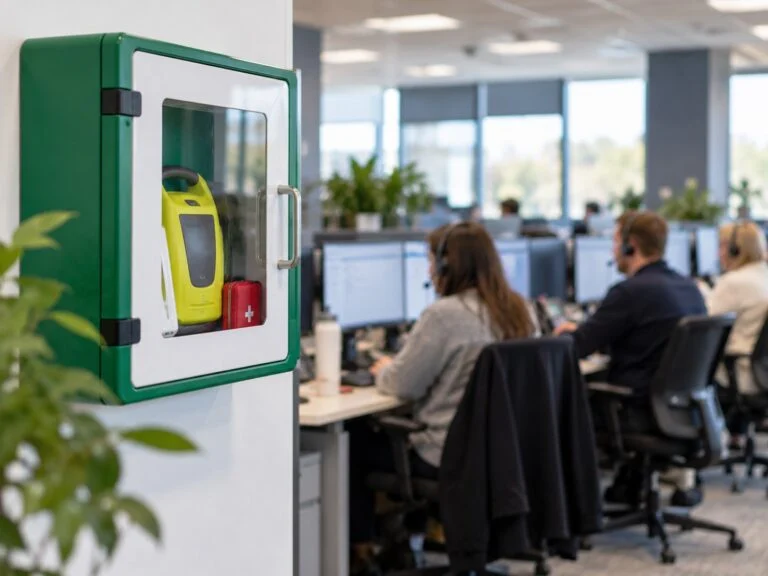
On the way in I passed a defibrillator on the wall by the kitchen. Its green light was on and the cabinet had clearly never been opened. Hold that thought.
9:00: who is your first aider?
I always start here, and the answer is almost never immediate. Three people pointed at a colleague called Dev. Dev pointed at the ceiling.
So we talked about the difference between an appointed person, who takes charge of the arrangements and calls 999, and a first aider, who has actually been trained. Then someone asked the better question: how many first aiders should we have?
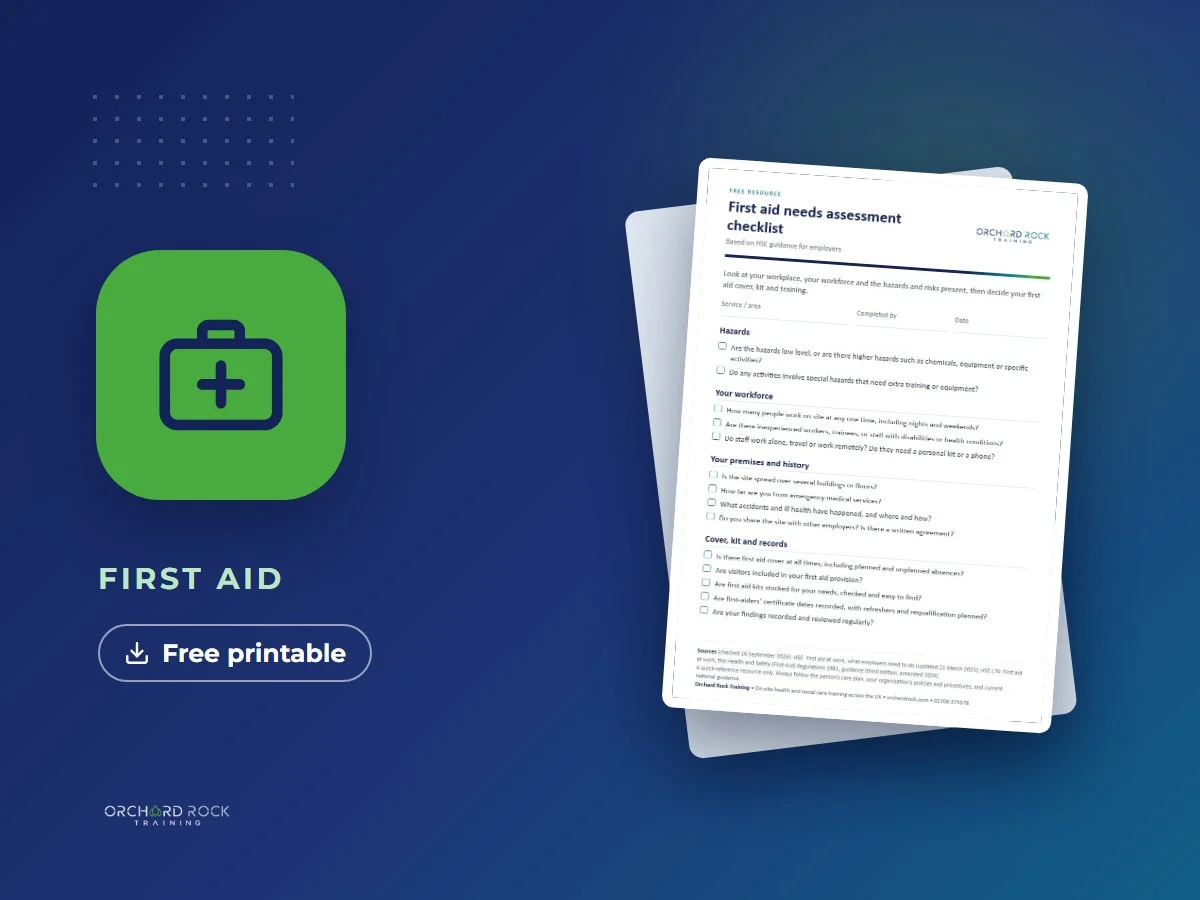
The honest answer is that the law does not give you a number. HSE says plainly that there are no hard and fast rules, so your first aid needs assessment decides, taking account of your hazards, your headcount, your shift patterns and how often people are away.
What HSE does give is a guide. In a low-hazard workplace with fewer than 25 employees, its suggested minimum is an appointed person; from 25 to 50, it suggests at least one first aider trained in EFAW. The phrase to watch is “available at all times people are at work”, and the team spotted that straight away, because half of them work evenings.
9:40: DRCABCDE, and the seatbelt rule
Next, the primary survey: Danger, Response, Catastrophic bleeding, Airway, Breathing, Circulation, Disability, Exposure.
The bit that surprises people every time is Danger. Your first job is not to reach the casualty, it is to make sure you do not become the second one. I call it the seatbelt rule. You put yours on first, then you help everyone else with theirs.
In an office that means looking for the trailing cable, the spilled drink and the chair that is about to roll into the back of your knees.
10:30: the middle of the chest, hard and fast
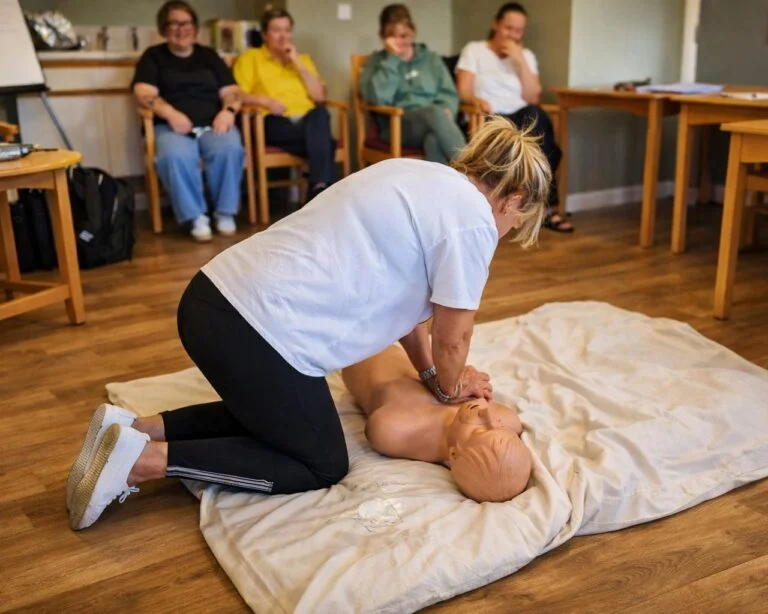
Then the manikins came out, and the room went quiet in the way it always does.
Chest compressions are hard work. Everyone knows that in theory, and nobody believes it until they have done two minutes. We practised in pairs, swapping over, and talked about how quickly you tire when you are on your own.
One delegate got the rhythm from the first go. She told us she had been in a choir for years, which may be the most useful piece of first aid training nobody advertises.
11:15: opening the cabinet
Then we went and got the defibrillator from by the kitchen.
This is my favourite five minutes of any workplace course. People are frightened of these machines, and then they open one. It talks to you. It tells you where to put the pads, it decides whether a shock is needed, and it will not let you shock someone who does not need it. You genuinely cannot get it wrong by trying.
While the cabinet was open, the facilities manager checked the pads. They expire, and so do the batteries. Nobody had looked since it went up. So that went on her list, and she was very calm about it, which I admired.
12:30: lunch, and the sandwich incident
Everyone came back from lunch with a sandwich, which was excellent timing, because the afternoon started with choking.
Back blows and abdominal thrusts, practised on each other with no force at all, then on the manikin properly. We also covered what a partly blocked airway looks like, and why you encourage someone to keep coughing while they still can.
1:30: the recovery position, and the office floor
Unconsciousness next, and the recovery position. Twelve people lying on carpet tiles, taking turns to roll each other over, all being very polite about it.
We talked about seizures too: do not restrain, do not put anything in their mouth, protect their head, note the time it starts. Timing a seizure sounds obvious until you try it, so we practised that as well.
2:15: the ones this team will actually meet
Every workplace has its own likely emergencies, so this is where an on-site course earns its keep. For a contact centre, that meant:
- Asthma: sit them up, help them use their own blue inhaler, stay calm with them. Two people in the room carry one
- Anaphylaxis: the auto-injector goes into the outer thigh, and you call 999 straight away, even if they improve
- Severe bleeding and shock: pressure, pressure and more pressure, and what shock looks like before it gets serious
- Burns: twenty minutes under cool running water, which always feels far longer than anyone expects
Sepsis came up here too. It can follow an infection that seemed minor, and the point I make is simple: if someone is getting worse rather than better, say so out loud and get help.
3:30: the accident book
Paperwork is nobody’s favourite session, so I keep it short. What you write down, when you write it, and why the record matters later.
The team leader admitted that their accident book was in a drawer that sticks. We agreed that a drawer that sticks is a filing system, technically, but not a good one.
4:15: headsets back on
We finished with scenarios, because knowing the steps and doing them while someone is talking at you are different skills.
As I packed up, Dev came over. He had spent the morning insisting he was “not a medical person”. He asked whether he could be the one to check the defibrillator pads each month.
That is what a good first aid day looks like. Not twelve experts, but twelve people who will step forward instead of stepping back, and one man with a calendar reminder.
Related training
- First Aid at Work (3 days): the full qualification, for higher-hazard workplaces and larger teams
- Mental Health First Aid (2 days): the other side of first aid at work: spotting and supporting mental ill health
Free resources
Download, print and share these with your team.