Why a first aid needs assessment matters
HSE says employers must assess their first aid needs, looking at the workplace, the workforce and the hazards and risks present. There are no hard and fast rules on exact numbers of first-aiders: the answer depends on the circumstances of your workplace.
Your assessment tells you what you need, for example:
- An appointed person to take charge of first aid arrangements, look after the equipment and facilities, and call the emergency services when needed. This is the minimum where first-aiders aren’t needed.
- First-aiders trained in Emergency First Aid at Work (EFAW) or First Aid at Work (FAW). HSE guidance says that where 25 or more people are employed, even in low-hazard workplaces, at least one first-aider should be provided.
- First aid kits stocked to suit your workplace, plus any extra equipment or a first aid room.
Care services and non-employees
Under the Health and Safety (First-Aid) Regulations 1981 there is no legal duty to provide first aid for non-employees, but HSE strongly recommends including them in your first aid provision. In a care service, that includes visitors. The health needs of the people you support should also be planned for in their care plans and your policies.
Choosing EFAW or FAW
First Aid at Work is a longer course that builds on Emergency First Aid at Work and covers a wider range of injuries and illnesses. HSE guidance says FAW and EFAW certificates are valid for three years, and strongly recommends annual refresher training in between.
The checklist
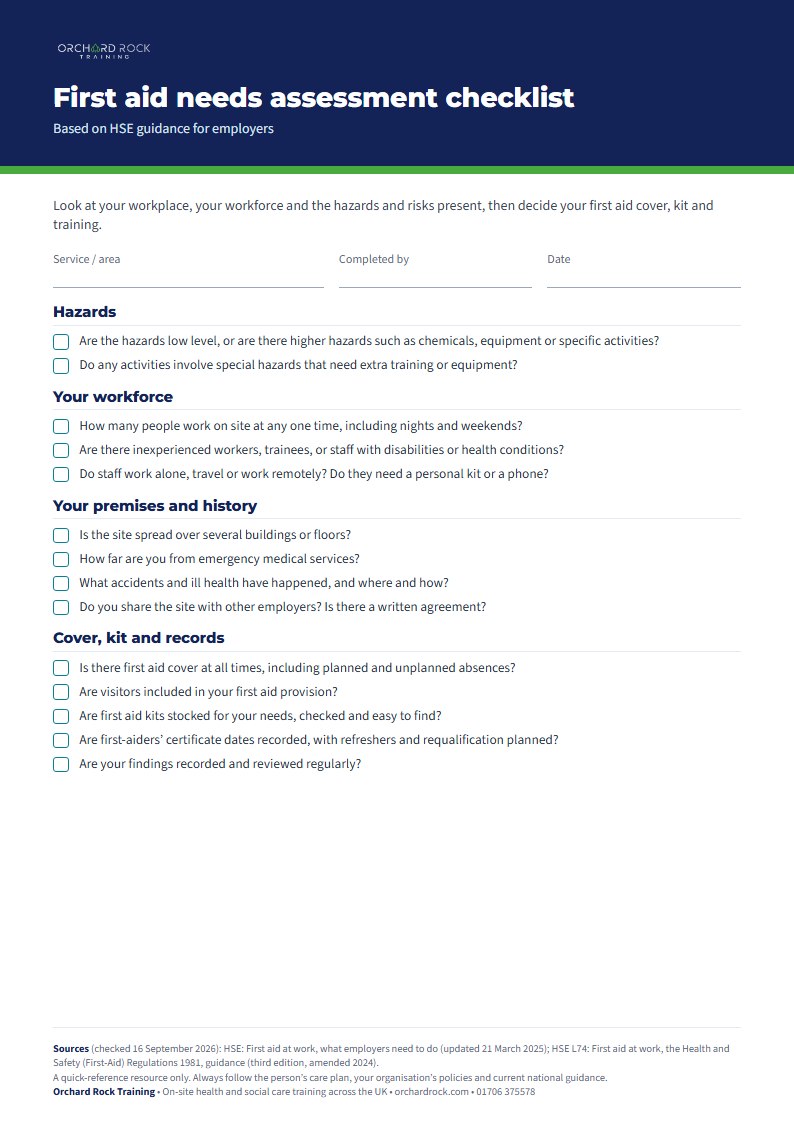
Hazards
- Are the hazards low level, or are there higher hazards such as chemicals, equipment or specific activities?
- Do any activities involve special hazards that need extra training or equipment?
Your workforce
- How many people work on site at any one time, including nights and weekends?
- Are there inexperienced workers, trainees, or staff with disabilities or health conditions?
- Do staff work alone, travel or work remotely? Do they need a personal kit or a phone?
Your premises and history
- Is the site spread over several buildings or floors?
- How far are you from emergency medical services?
- What accidents and ill health have happened, and where and how?
- Do you share the site with other employers? Is there a written agreement?
Cover, kit and records
- Is there first aid cover at all times, including planned and unplanned absences?
- Are visitors included in your first aid provision?
- Are first aid kits stocked for your needs, checked and easy to find?
- Are first-aiders’ certificate dates recorded, with refreshers and requalification planned?
- Are your findings recorded and reviewed regularly?
What goes in a first aid kit?
There is no mandatory list. HSE guidance says the contents should reflect your needs assessment, and suggests a minimum stock for low-hazard work might be:
- a leaflet with general guidance on first aid
- 20 individually wrapped sterile plasters (assorted sizes)
- 2 sterile eye pads
- 2 individually wrapped triangular bandages, preferably sterile
- 6 safety pins
- 2 large and 6 medium sterile, individually wrapped, unmedicated wound dressings
- at least 3 pairs of disposable gloves
Employers may also refer to British Standard BS 8599, which gives more information on workplace first aid kits.
Download and printChecklist (PDF, 1 page). Free to use in your service.
Download the PDFThis is a quick-reference resource. Always follow the person’s care plan, your organisation’s policies and procedures, and current national guidance.
Sources (checked 16 September 2026): HSE: First aid at work, what employers need to do (updated 21 March 2025); HSE L74: First aid at work, the Health and Safety (First-Aid) Regulations 1981, guidance (third edition, amended 2024).