What the law says
In England and Wales, article 15 of the Regulatory Reform (Fire Safety) Order 2005 says the responsible person must nominate a sufficient number of competent persons to carry out the evacuation procedures. Those people are what most workplaces call fire marshals or fire wardens.
The Order does not give a figure, and neither does the government’s guidance on fire safety in the workplace. “Sufficient” depends on your building and the people in it. Your fire risk assessment is where you work the number out and write it down.
“Competent” has a meaning too. The Order says it is someone with enough training and experience, or knowledge and other qualities, to carry out the evacuation procedures properly. Scotland and Northern Ireland have their own fire safety law, but you answer the question in the same way.
What about one marshal for every 20 or 50 people?
You will see ratios like these quoted online. They can be a rough starting point, but they are not in the Fire Safety Order or in the government guidance. They also miss the things that matter most: your layout, your shifts and who needs help to get out. A care home with 30 residents asleep at night needs a very different answer from an office with 30 desks.
Five things that decide your number
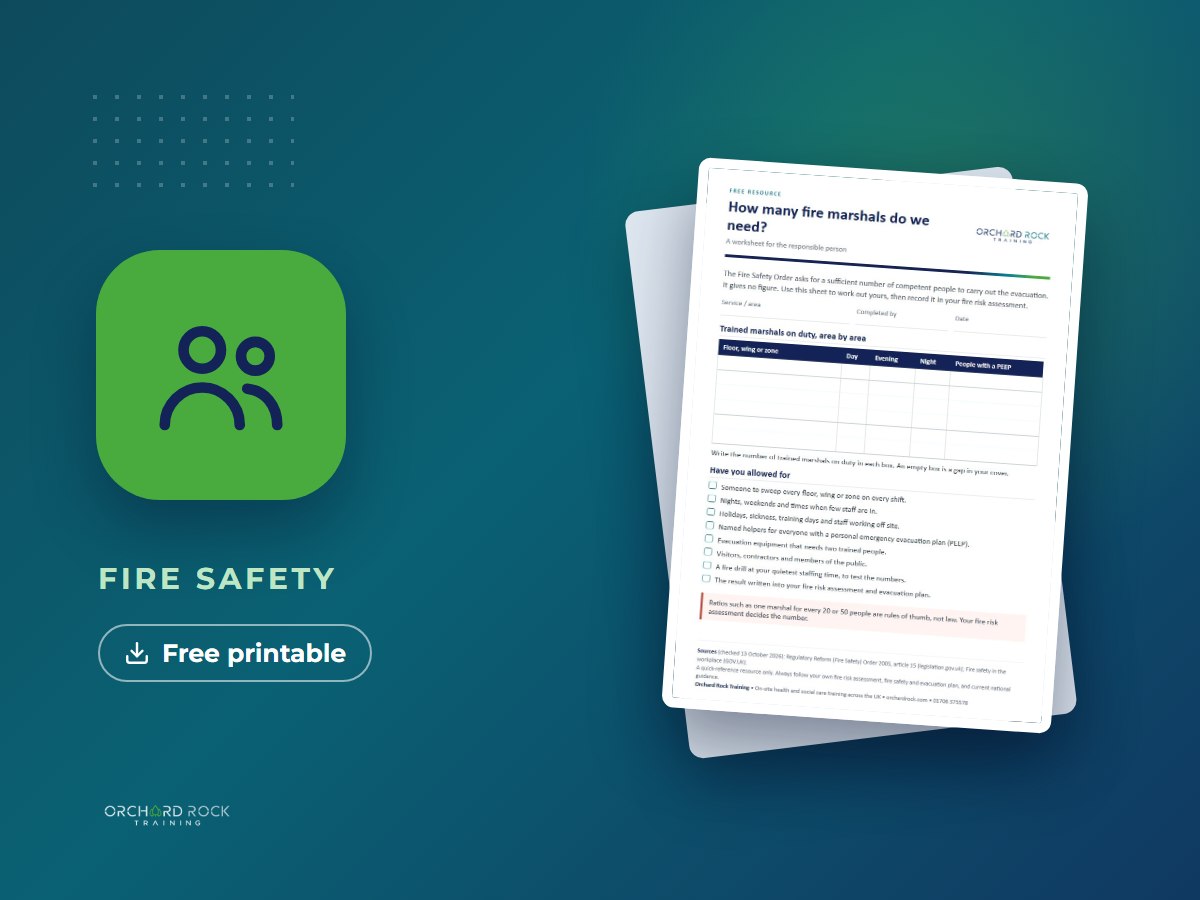
- Areas to check. Every floor, wing or zone needs someone to sweep it and confirm it is clear. Count the areas one person can check quickly.
- Shifts and opening hours. You need enough marshals on duty whenever people are in the building, including nights, weekends and times when few staff are in.
- Absence. Holidays, sickness, training days and staff working off site all reduce your cover. So train more people than the bare minimum.
- People who need help to leave. Anyone with a personal emergency evacuation plan (PEEP) needs named people to help them, and some evacuation equipment needs two trained people to use it.
- Level of risk. Sleeping accommodation, kitchens, oxygen, flammable substances and members of the public on site all push the number up.
How to work it out
- First, list every area that would need checking in an evacuation.
- Then, for each shift, write down who is on duty and trained for each area.
- Next, add the people needed to help anyone with a PEEP on that shift.
- Add cover for absence, so the plan still works when someone is off.
- Test it with a fire drill, including at your quietest staffing time, and change the numbers if the drill shows a gap.
- Finally, record the result in your fire risk assessment and your evacuation plan. Review it whenever the building, the people or the staffing change.
Care homes and other places where people sleep
Night shifts are usually the hardest to cover. Fewer staff are on duty, people are in bed and many will need help to move. Many care homes plan a zonal evacuation, moving people through fire doors into a safer part of the building first, because getting everyone outside at once is not always possible.
So start with the night shift. Are there enough trained people on duty to carry out the plan for every person’s PEEP? If the honest answer is no, the plan, the training or the staffing has to change.
Keeping your marshals competent
- Train marshals for your own building and your own plan, not only the theory.
- Make sure every member of staff knows who the fire marshals are.
- Carry out at least one fire drill a year, and record the results.
- Refresh the training when the plan, the building or the people change.
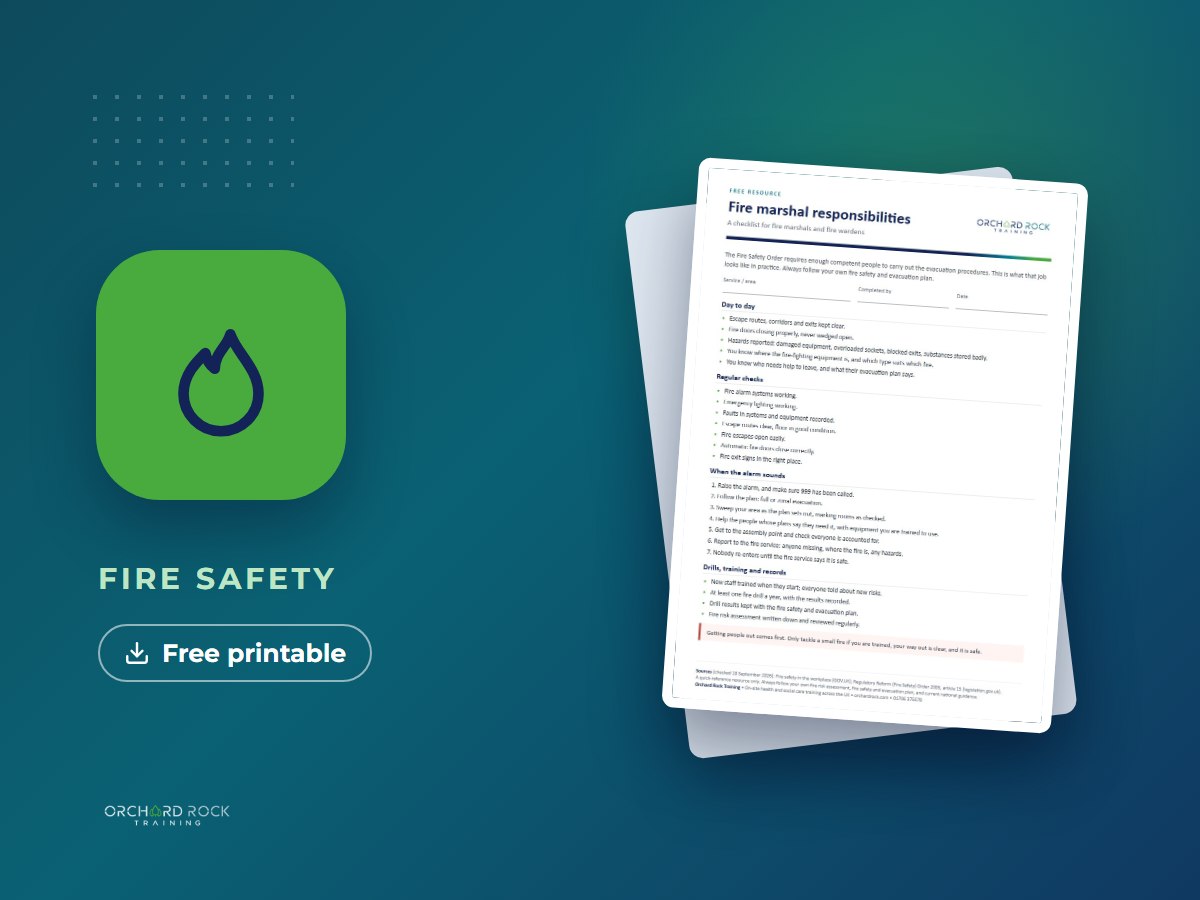
For what the role involves day to day and when the alarm sounds, see our fire marshal responsibilities checklist.
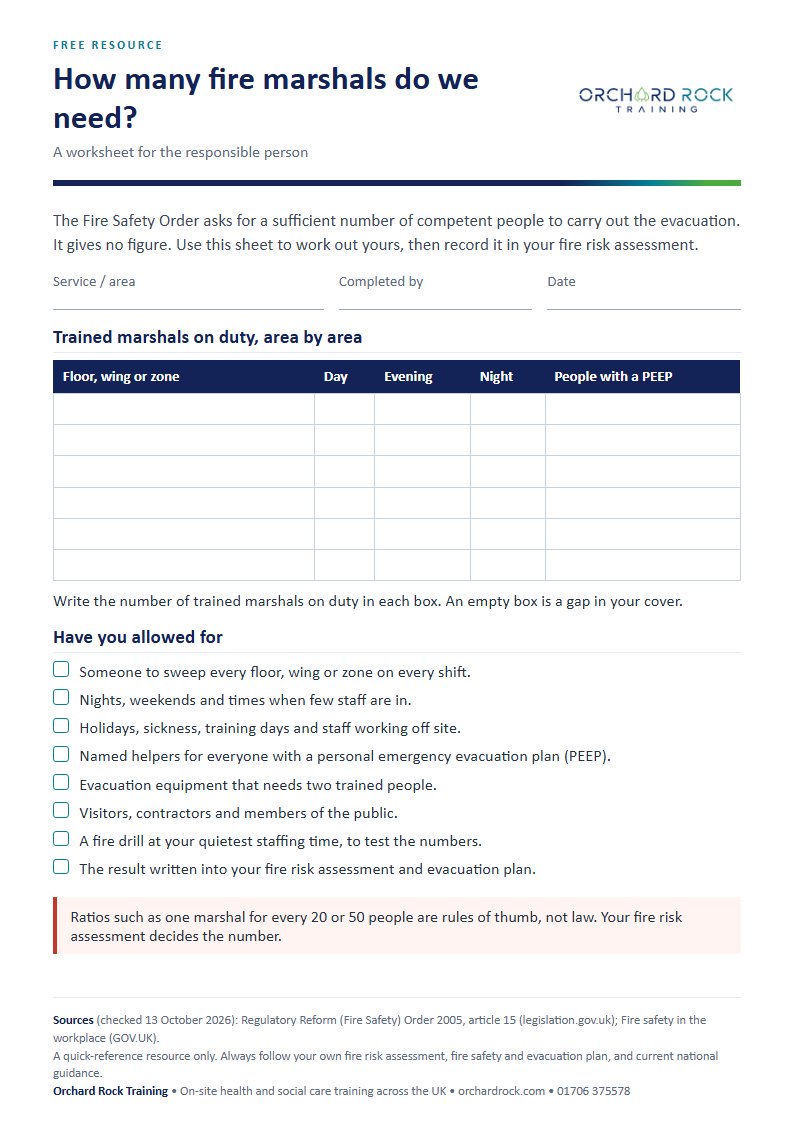
Download and printWorksheet (PDF, 1 page). Free to use in your service.
This is a quick-reference resource. Always follow your own fire risk assessment, fire safety and evacuation plan, and current national guidance.
Sources (checked 13 October 2026): Regulatory Reform (Fire Safety) Order 2005, article 15 (legislation.gov.uk); Fire safety in the workplace (GOV.UK).