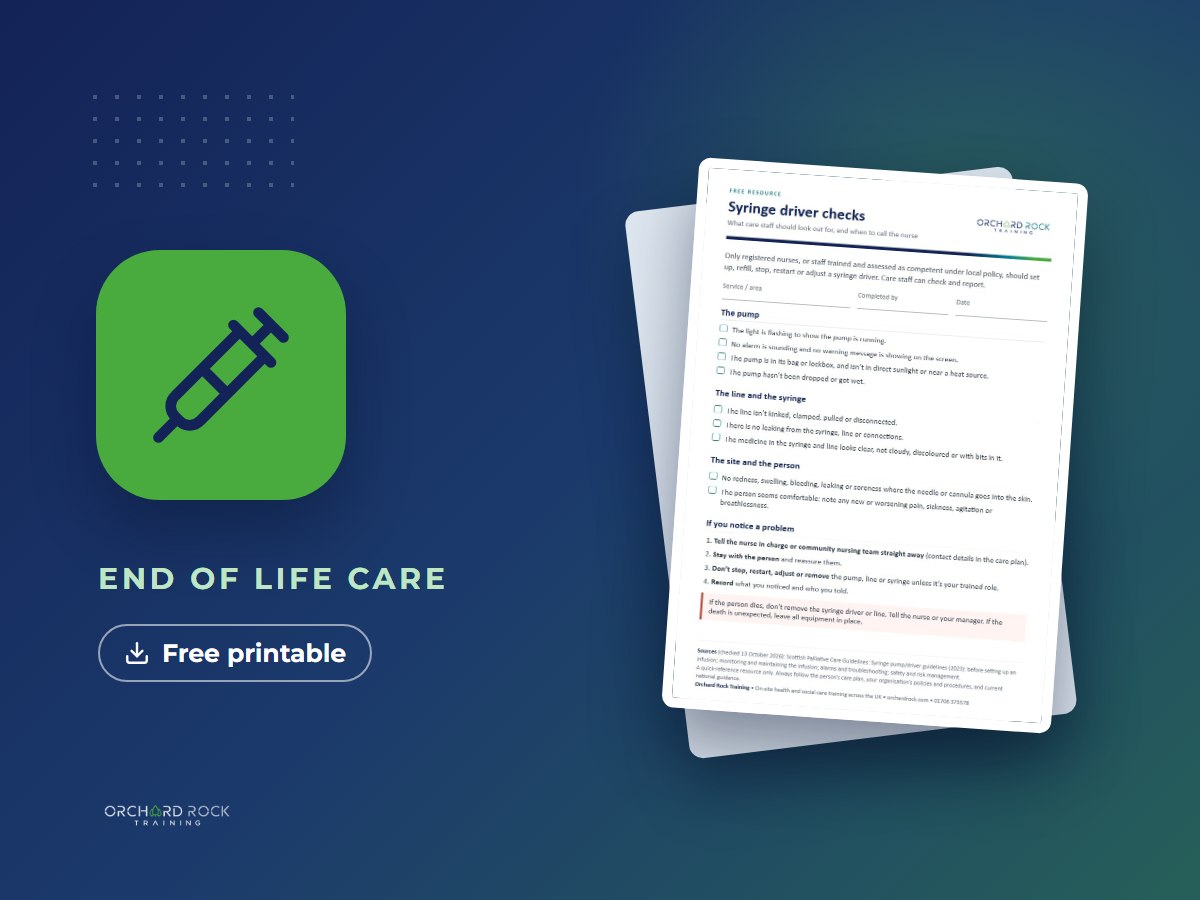
Only registered nurses, or staff trained and assessed as competent under your local policy, should set up, refill, stop, restart or adjust a syringe driver.
What is a syringe driver?
A syringe driver (also called a syringe pump) is a small, portable, battery-operated pump. It gives medicine slowly and continuously under the skin (a subcutaneous infusion), usually over 24 hours.
It is often used in palliative and end of life care when taking medicines by mouth isn’t possible or isn’t working well, for example when someone has difficulty swallowing, their condition is deteriorating, or they have ongoing nausea and vomiting.
Who does what
The syringe driver is set up and managed by registered nurses, or by staff who are trained and assessed as competent under local policy. Care staff play an important part by noticing problems and reporting them quickly. If you aren’t trained and authorised, don’t try to fix the pump, the line or the syringe yourself.
What to look out for
The pump
- The light is flashing to show the pump is running.
- No alarm is sounding and no warning message is showing on the screen.
- The pump is in its bag or lockbox, and isn’t in direct sunlight or near a heat source.
- The pump hasn’t been dropped or got wet.
The line and the syringe
- The line isn’t kinked, clamped, pulled or disconnected.
- There is no leaking from the syringe, line or connections.
- The medicine in the syringe and line looks clear, not cloudy, discoloured or with bits in it.
The site and the person
- No redness, swelling, bleeding, leaking or soreness where the needle or cannula goes into the skin.
- The person seems comfortable: note any new or worsening pain, sickness, agitation or breathlessness.
What to do if you notice a problem
- Tell the nurse in charge or the community nursing team straight away, using the contact details in the person’s care plan.
- Stay with the person and reassure them.
- Don’t stop, restart, adjust or remove the pump, line or syringe unless you’re trained, competent and it’s your role.
- If the pump has been dropped or got wet, report it, because it will need to be checked.
- Record what you noticed and who you told, in line with your policy.
How often are checks done?
The Scottish Palliative Care Guidelines say the nurse should check the infusion within 15 to 30 minutes of setting it up, then every 4 hours in an inpatient setting and at every visit (at least daily) in the community. Care staff can keep an eye on the pump, line and site at every contact in between, and report anything that doesn’t look right.
If the person dies
Don’t remove the syringe driver or the line. Tell the nurse or your manager, who will follow local policy. If the death is unexpected, or there are any concerns about the circumstances, all equipment must be left in place.
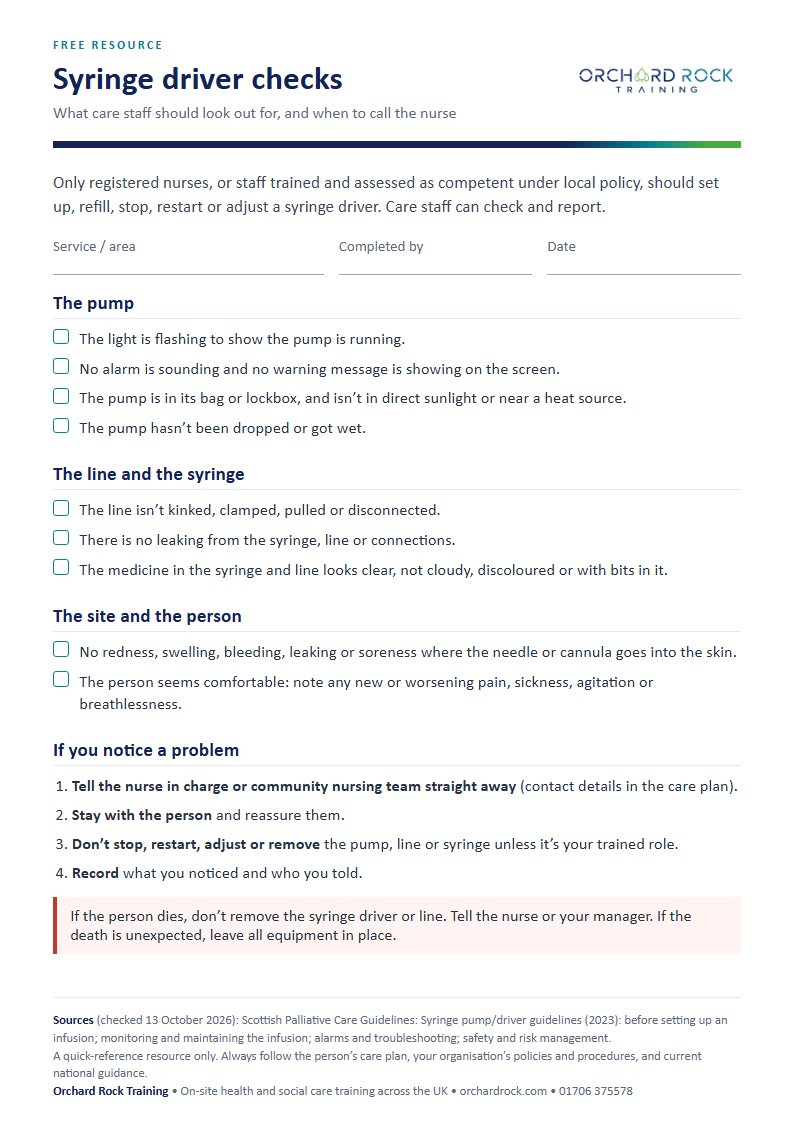
Download and printChecklist (PDF, 1 page). Free to use in your service.
This is a quick-reference resource. Always follow the person’s care plan, your organisation’s policies and procedures, and current national guidance.
Sources (checked 13 October 2026): Scottish Palliative Care Guidelines: Syringe pump/driver guidelines (2023): before setting up an infusion; monitoring and maintaining the infusion; alarms and troubleshooting; safety and risk management.