This is for registered nurses who have been trained and assessed as competent to verify expected adult deaths under local policy. It does not replace training or your local policy.
Recognition, verification and certification
- Recognition of death: relatives, care home staff and others can recognise that death has happened.
- Verification of death: formally documents the death. The time of verification is recorded as the official time of death.
- Certification of death: a medical practitioner completes the Medical Certificate of Cause of Death (MCCD). Medical Examiners review proposed causes of death.
Families should be told that the time of the last breath and the official time of death will be different.
When the guidance applies
- The person is an adult (over 18) and the death was expected.
- There are no suspicious circumstances.
- A DNACPR decision is in place, or the person is found deceased without one and there are signs of irreversible death, such as rigor mortis.
- The death happens at home, in a hospice, care home, nursing home or hospital, including where the person was under the Mental Health Act or DoLS.
Hospice UK describes timely verification as within one hour in hospital and within four hours in the community. The verifying nurse has the right to refuse to verify a death and to ask for the responsible doctor, or the police, if anything is unusual.
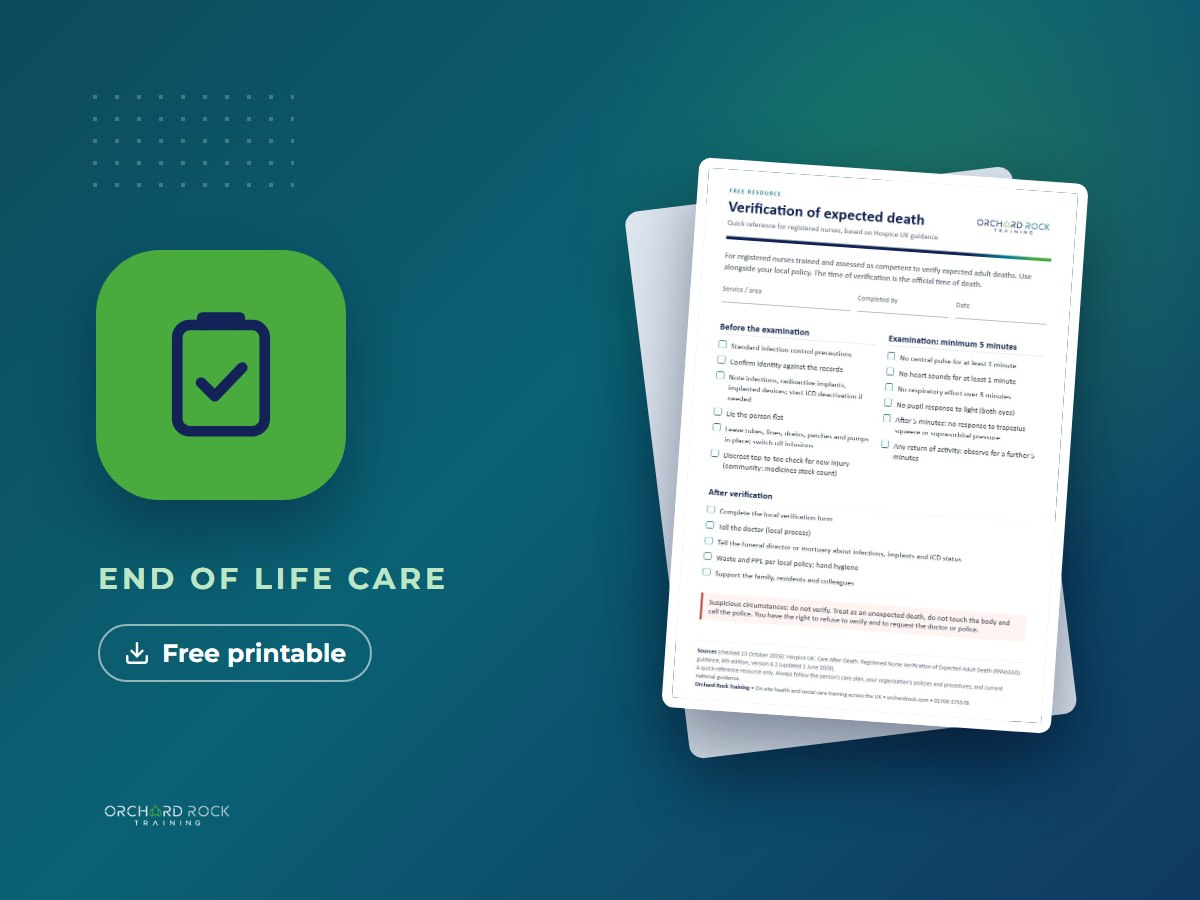
Before the examination
- Use standard infection control precautions.
- Check the person’s identity against their records.
- Identify any known or suspected infections, radioactive implants or implanted devices, and start the process to deactivate an implantable cardiac defibrillator (ICD) if it is still active.
- Lie the person flat.
- Leave tubes, lines, drains, patches and pumps in place, switching off any infusions, and explain why to anyone present.
- Consider a discreet top-to-toe check for new signs of trauma or injury. In the community, review the stock count of medicines.
If there are suspicious circumstances, don’t verify. Treat it as an unexpected death, don’t touch the body, and call the police.
The verification examination
Observe the person for a minimum of five minutes to establish that irreversible cardio-respiratory arrest has happened:
- Central pulse: absent on palpation for at least one minute.
- Heart sounds: absent on auscultation for at least one minute.
- Breathing: no respiratory effort seen over the five minutes.
- Pupils: no response to light in either eye.
- Motor response: after five minutes of continued arrest, no response to trapezius squeeze or supra-orbital pressure.
Any return of heart or breathing activity means a further five minutes of observation. If you have any doubts, speak to the GP or another medical practitioner.
After verification
- Complete your local verification of death form. The time of death is when verification is completed.
- Tell the doctor, using your locally agreed process.
- Tell the funeral director or mortuary about any infections, radioactive implants, implanted devices and whether an ICD is still active.
- Dispose of waste and remove PPE in line with local policy, then clean your hands.
- Support the family, and think about the impact on other residents and colleagues.
Deaths that must be referred to the coroner
Hospice UK lists situations including when the cause of death is unknown, when it may have been caused by violence, trauma, injury, poisoning, self-harm, neglect or failure of care, when it may be related to a medical procedure or to work, or when the person was in custody or state detention. Know what your local coroner expects.
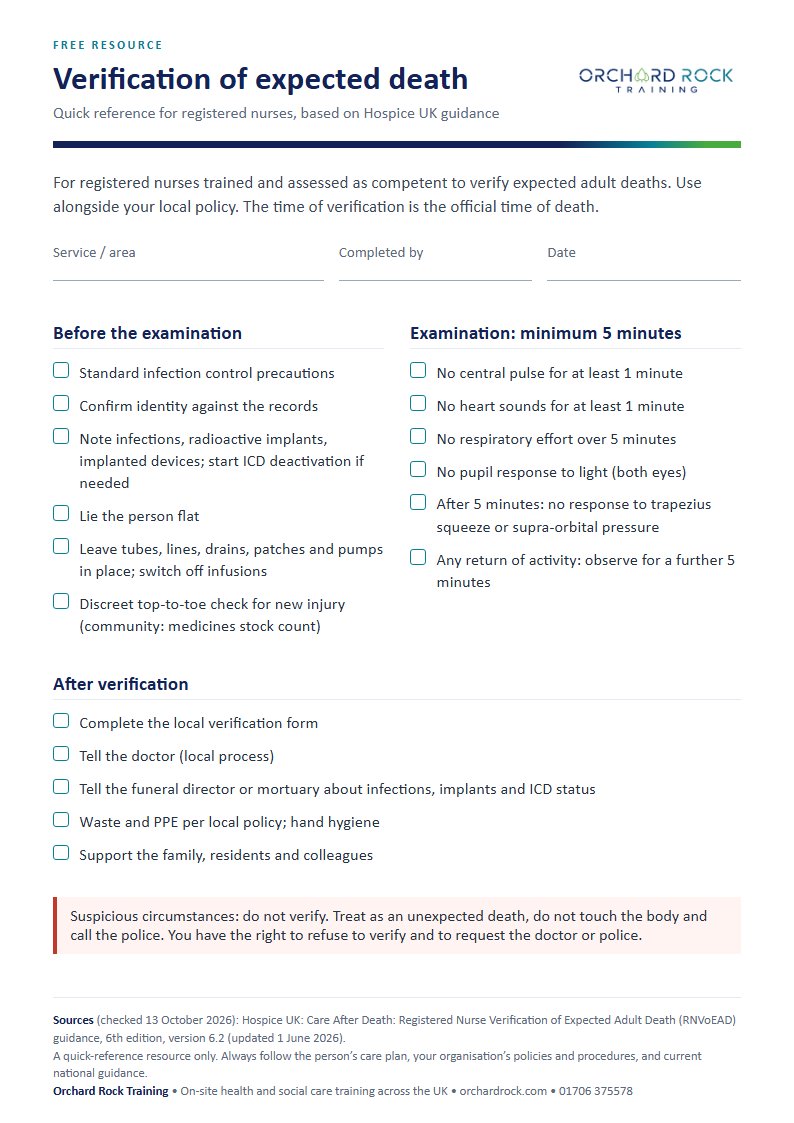
Download and printQuick reference (PDF, 1 page). Free to use in your service.
This is a quick-reference resource. Always follow the person’s care plan, your organisation’s policies and procedures, and current national guidance.
Sources (checked 13 October 2026): Hospice UK: Care After Death: Registered Nurse Verification of Expected Adult Death (RNVoEAD) guidance, 6th edition, version 6.2 (updated 1 June 2026).