

It is 3.07 in the morning and I am staring at the ceiling again. The dog is snoring beside me, completely at peace. My brain is running a triathlon.
There is no reason for it. I am not uncomfortable. I am not even particularly stressed. My mind has simply decided that now is the ideal moment to revisit every awkward conversation I have ever had.
I have ADHD. I am also autistic. And I am not the person bouncing off the walls.
That is worth saying, because the picture most people carry around is a child who cannot sit still, and it means an adult who sits perfectly calmly through a two-hour meeting gets written off as not having it. I can look relaxed. I can look like I am doing nothing at all. Meanwhile my brain is doing an enormous amount of work.
The NHS puts it simply: ADHD is a condition where the brain works differently to most people. It also notes that ADHD is recognised less often in women, partly because inattentive symptoms are harder to spot than hyperactive ones. I recognise myself in that sentence more than in any list of symptoms.
So since it is ADHD Awareness Month, here is what it actually feels like, rather than what it looks like.
The hyperactive bit is my brain, not my body
My brain is busy, fast and noisy. It makes connections constantly, whether or not I have asked it to. I can be sitting completely still on a sofa while there are twenty things running at once: a plan, an idea, something I need to remember, a conversation from this morning I am quietly replaying, and a sudden fascination with something entirely unrelated.
From the outside, that is a woman sitting still. From the inside, it is rush hour.
I like being active. I walk, I play football. Enjoying movement is a completely different thing from being physically hyperactive, and the two get muddled all the time.

Two radio stations, both loud
Having ADHD and being autistic means the two do not politely take turns.
The ADHD side races ahead, full of ideas and distractions. The autistic side wants calm, structure and predictability. It is like living with two radio stations playing at once, both demanding attention.
I start the day with coffee, because coffee feels like control. I look at my to-do list, neatly written and colour coded, and tell myself that today is the day I stick to it. By mid-morning I am usually knee deep in something else that felt urgent at the time. ADHD loves a detour. Autism hates one. My brain has a front row seat to its own argument.
Knowing what to do and being able to start are not the same thing
This is the part I most want people to understand, because it is the part that looks like laziness.
Often I know exactly what needs doing. I want to do it. I understand why it matters. I have planned it. And I still cannot make myself start.
It is as though my brain does not quite kick in and connect with the rest of me. The intention is there. The activation is not.
Take going for a walk. I think: I should go. I want to go. I will feel better if I go. I know it is good for me. And I do not move.
Then the guilt arrives, because I know I am capable of it. Then the shame, because what kind of person cannot go for a walk. The shame makes me feel worse, and feeling worse makes starting harder still. Intention, no activation, guilt, shame, less chance of starting. Round it goes.
Which is why “just do it” is such a useless sentence. The problem was never knowing what to do.
The sofa problem
Here is a small, specific example that explains more than any definition.
Coming home from work, there is a world of difference between being outside and already moving, and being through the front door with my shoes off. Once I see the sofa, the barrier gets much higher. The sofa is a giant switch-off trigger. It tells my brain the day is finished.
So I walk the dog before I properly land in the house. Not because I have more willpower on those days, but because I have taken out the moment where my brain gets to decide everything is over.
A lot of what works for me is like that. It is not discipline. It is arranging things so my brain does not have to fight itself.

Why I could do it yesterday and not today
One of the strangest parts is the inconsistency, and it confuses other people as much as it confuses me.
If I managed it yesterday, why not today? If I can lose hours in something complicated, why can a two-line email sit there for a week? If I can be completely absorbed in a subject that grips me, why does putting something away feel impossible?
For me it is not an inability to focus. It is attention that does not take instructions. Sometimes I cannot get my attention onto a thing. Sometimes I cannot pull it off a thing. Occasionally both in the same afternoon.
The systems are not tidiness, they are survival
When I wash up, the spoons, knives and forks go in separate piles, so that putting them away later takes seconds. The plates line up largest to smallest. If I do not empty the washing machine the moment it finishes, I will end up washing the whole load again because of the smell. I sort the clothes into the order I am going to hang them, because otherwise I will get distracted halfway through.
From the outside that is somebody who likes things neat. It is actually somebody protecting tomorrow’s energy. Every decision I can take out of the future is one I will not have to find the fuel for later.
Work is the same. Tidy desk, labelled files, precise lists. Not because tidiness matters to me for its own sake, but because when my workspace gets cluttered my head follows within the hour.
The other side of it
I do not want to tell only the difficult half, because the same brain does things I would not give up.
When something genuinely interests me, I can go all the way in. Deep, absorbed, hours gone, problem solved. That is how a lot of my best work happens.
It also makes connections quickly, often before I have consciously worked out why. That is the same brain that cannot start a simple admin task.
The structure keeps me stable. The chaos keeps me creative. I have stopped trying to choose between them, because together they are the whole of how I work.
Ability is rarely the problem. Getting access to the ability at the moment I need it is the problem.
Urgency is not a character test
A deadline can change everything. Something I have failed to start for a fortnight becomes possible in an hour when there is a real consequence attached.
That looks damning. “You managed it when you had to, so you could have done it all along.” But the conditions were not the same. Urgency supplied the stimulation my brain was short of. It is not evidence that the earlier struggle was invented.
Perfectionism gets there first
Sometimes I do not start because I cannot face doing it badly. I need to do this. I need to do it properly. What if I cannot. What if I look stupid. What if people notice.
And then I do nothing at all, which is of course the one outcome I was trying to avoid.
When somebody turns the volume up
Noise, bright light, several people talking at once. It can feel as though every volume knob in my head has been turned up at the same time, and I cannot tune any of it out. My brain records every sound, every movement, every flicker.
I can go from fine to completely overwhelmed in seconds. Sometimes I need quiet. Sometimes I need to leave altogether.
Burnout arrives slowly and then all at once. When it does, I stop talking, stop answering messages, and stare at a wall while something resets. It is not laziness. It is recovery.
Rejection sensitivity
This one is harder to explain, and I want to be careful with it. Rejection sensitive dysphoria, or RSD, is a term people use for an intense emotional response to rejection or criticism, real or perceived. It is not a formal diagnostic criterion for ADHD. It is, however, a very accurate description of something I experience.
A small interaction can land enormously. I replay conversations. I analyse a tone of voice. I decide I have let someone down. The feeling arrives fully formed, before I have had any chance to assess what actually happened.
The useful thing I have learned is that the size of the feeling tells me nothing reliable about the size of the event. Something can feel like catastrophic rejection and simply not be. Knowing that does not stop the feeling. It does give me somewhere to stand while it passes.
What help actually looks like
My partner understands this in a way I could not explain to anybody. When I say I am struggling, she does not ask what is wrong. She already knows. Sometimes it is a hug. Sometimes she takes over a conversation so that I do not have to think. She can see which situations will overwhelm me, and she steps in before they do.
It is a quiet sort of teamwork, and the reason it works is that it never makes me feel incapable. Nobody announces it. Nobody makes a fuss. Someone simply notices the shutters starting to come down and takes one thing off me.
That is worth knowing if you manage people, because it is exactly the same skill: noticing early, and helping in a way that does not cost somebody their dignity.
What it looks like, and what is happening
From the outside
- Sitting quietly, apparently relaxed
- Not started the thing yet
- Brilliant one day, floundering the next
- Fine with the hard job, stuck on the easy one
- Gone quiet, not answering messages
From the inside
- Twenty thoughts at once and no volume control
- Wanting to start and unable to begin
- Same ability, different access to it
- Complicated is stimulating; dull is unreachable
- Overloaded, and resetting as fast as I can

What actually helps
None of this is a cure, and I am not interested in pretending I have beaten anything. These are the things that genuinely make my days work better.
- Doing it small. Ten minutes counts. One task counts. A short walk counts
- Removing the switch-off moment rather than trying to overpower it
- Starting while the resistance is still there, instead of waiting for it to lift
- Refusing the all-or-nothing deal, where anything less than the full version feels pointless
- Building the systems that save tomorrow’s energy, and not apologising for them
- Asking what is making this hard to start, instead of asking what is wrong with me
The line I come back to
I can feel resistance and still move. The resistance does not have to go first.
And to be clear, none of this is an excuse. ADHD does not remove my responsibility for anything. It explains the mechanism, and knowing the mechanism is what lets me work with my brain instead of fighting it. There is a real difference between “I cannot do this” and “this is harder for me, so I need a different way in”.
Why a training company is writing this
Because our trainers see this in every room they teach in. Not only in the people being supported, which is how ADHD and autism usually get discussed in care, but in the teams themselves: ADHD staff, autistic staff, managers, nurses.
They are often the ones who spot the thing nobody else has noticed, and who dread the online form that takes four minutes. If the only picture a team has of ADHD is a restless child, they will miss both halves of that.
So if you take one thing from this: the next time someone capable cannot seem to start something simple, consider that you may be watching a barrier rather than a choice. Ask what would make it easier to begin. It is a better question than any amount of encouragement to try harder.
If any of this sounds familiar
I am describing my own experience, not diagnosing anyone. If these things are affecting your work, your studies or your relationships, the NHS advice is to make an appointment with a GP, who will ask how the symptoms affect your life and can refer you for an assessment. ADHD UK has plain, practical information while you wait, which is often the hardest part.
And if you recognised yourself in any of this: you are not a faulty version of someone else. That shift, from “what is wrong with me” to “what is happening here, and what does my brain need”, is the single most useful thing I have done.
Maybe being wired a bit wrong in all the right places simply means I was built to move to my own rhythm.
Related training
- ADHD Awareness (half day): what ADHD is, how differently it shows up from one person to the next, and what helps
- Autism Awareness (half day): the same question from another angle: what the behaviour you can see is telling you
- Mental Health Awareness (half day): for teams who want to talk about this properly rather than carefully
- Workplace Culture (half day): the adjustments that cost nothing and the habits that quietly cost people
Free resources
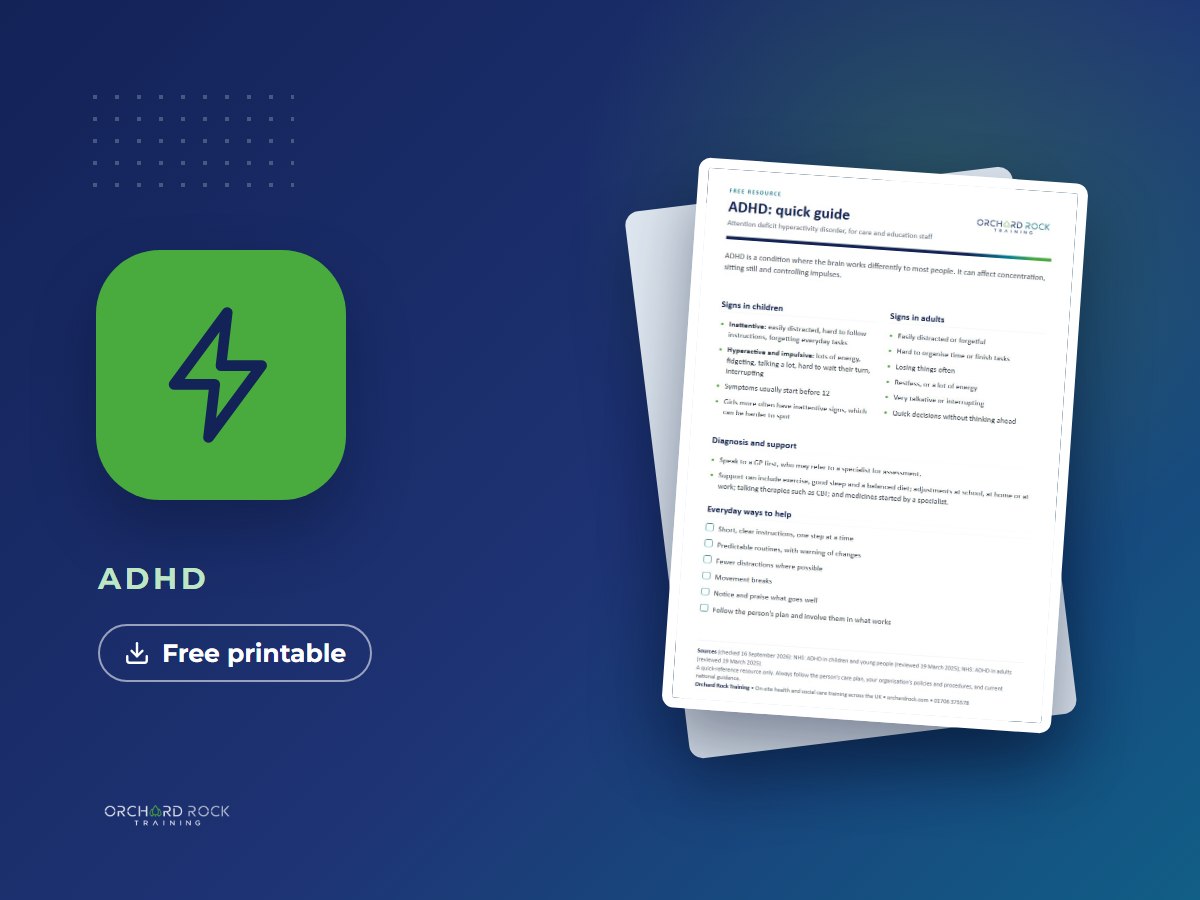
Download, print and share these with your team.
Sources: NHS, ADHD in adults; ADHD Awareness Month; ADHD UK. Correct as of 2 October 2026.