Does the law say you need a fire marshal?
Not in those words, but the duty is there all the same. In England and Wales the Regulatory Reform (Fire Safety) Order 2005 puts the duty on the responsible person: the employer, owner, landlord, occupier, or anyone else with control of the premises, such as a facilities or building manager. Article 15 of the Order says the responsible person must nominate a sufficient number of competent people to carry out the evacuation procedures. In practice, those competent people are what almost every workplace calls fire marshals or fire wardens.
Scotland and Northern Ireland have their own fire safety rules, but the practical job is the same.
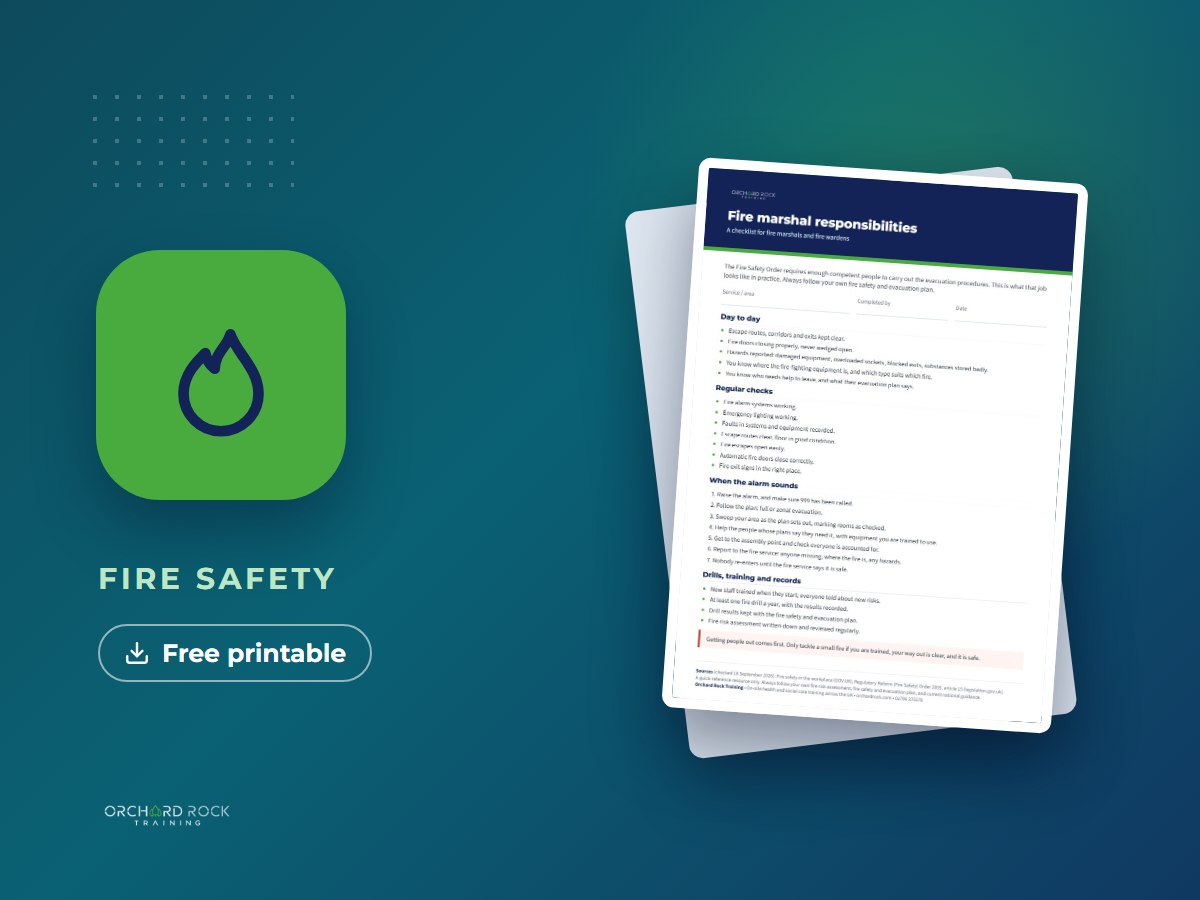
Day to day
- Keep escape routes, corridors and exits clear, and the floor in good condition.
- Check fire doors close properly, and never leave one wedged open.
- Report hazards to the responsible person: damaged equipment, overloaded sockets, blocked exits, hazardous substances stored badly.
- Know where the fire-fighting equipment is, and which type suits which fire.
- Know who would need help to leave the building, and what their personal emergency evacuation plan says.
Regular checks
As well as the risk assessment, GOV.UK sets out the checks the responsible person must make sure happen. Your own fire safety plan sets how often, so check it first.
- All fire alarm systems are working.
- The emergency lighting is working.
- Any faults in systems and equipment are recorded.
- All escape routes are clear and the floor is in good condition.
- All fire escapes can be opened easily.
- Automatic fire doors close correctly.
- Fire exit signs are in the right place.
When the alarm sounds
- First, raise the alarm if you are the one who finds the fire, and make sure 999 has been called.
- Then follow your plan, whether that is a full evacuation or a zonal one.
- Sweep your area the way your plan sets out, and mark rooms as checked so nobody is searched for twice.
- Help the people whose evacuation plans say they need it, using only the evacuation equipment you have trained on.
- Next, go to the assembly point and check everyone is accounted for.
- Report to the fire and rescue service: anyone missing, where the fire started, and any hazards they should know about.
- Finally, nobody goes back inside until the fire and rescue service says it is safe.
Putting a fire out is never the priority: getting people out is. Only use an extinguisher on a small fire if you are trained to, you have a clear way out behind you, and it is safe to try.
Drills, training and records
- Train new staff as soon as they start, and tell everyone whenever a new fire risk appears.
- Carry out at least one fire drill a year, and record the results.
- Then keep the drill results with your fire safety and evacuation plan.
- Keep a written record of the fire risk assessment, and review it regularly.
Know your own building
A fire marshal who knows the building beats one who knows the theory. So make sure every marshal can say, without looking it up, who the responsible person is, where the alarm panel is, where the assembly point is, which areas they sweep, and who in those areas needs help to get out.
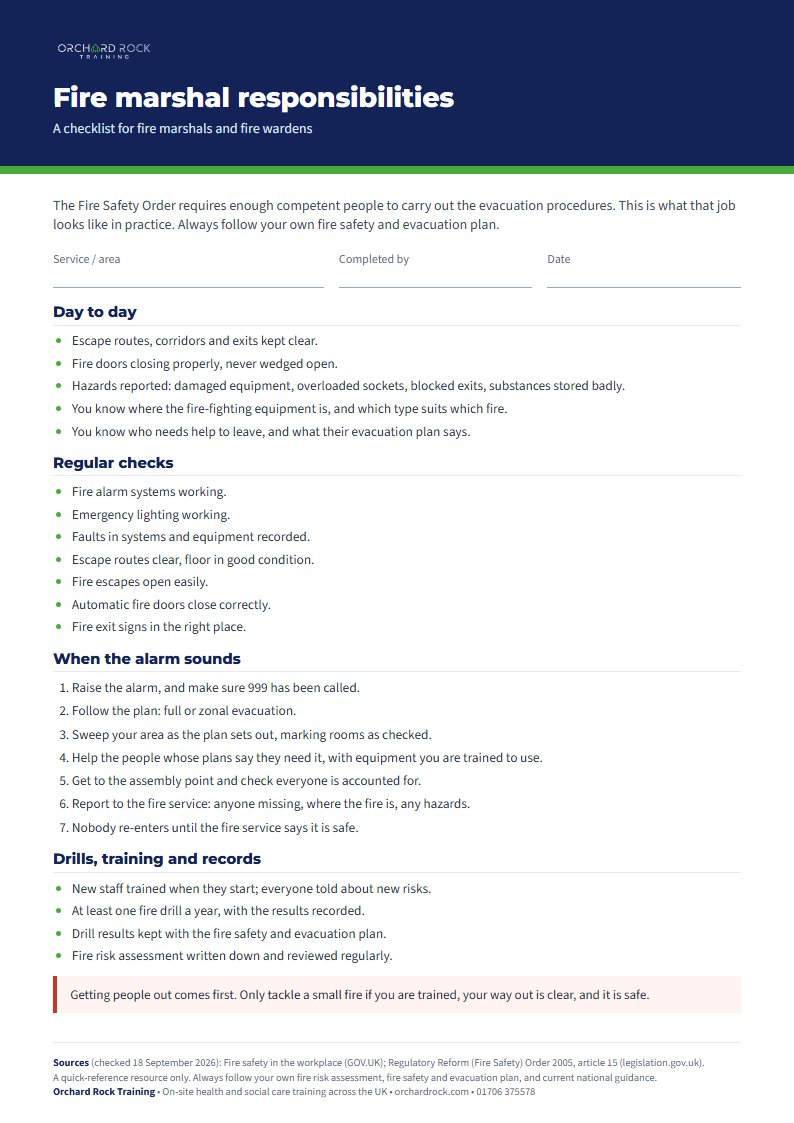
Download and printChecklist (PDF, 1 page). Free to use in your service.
This is a quick-reference resource. Always follow your own fire risk assessment, fire safety and evacuation plan, and current national guidance.
Sources (checked 18 September 2026): Fire safety in the workplace (GOV.UK); Regulatory Reform (Fire Safety) Order 2005, article 15 (legislation.gov.uk).