Emergency First Aid at Work, First Aid at Work, First Aid Awareness, Basic Life Support. Four courses, similar names, and lengths that run from three hours to three days.
The law helps less than you might hope, because it names none of them. Instead, the Health and Safety (First-Aid) Regulations 1981 ask you to provide first aid that is adequate and appropriate for your own workplace. So the answer to “which first aid course do we need?” always starts in the same place.
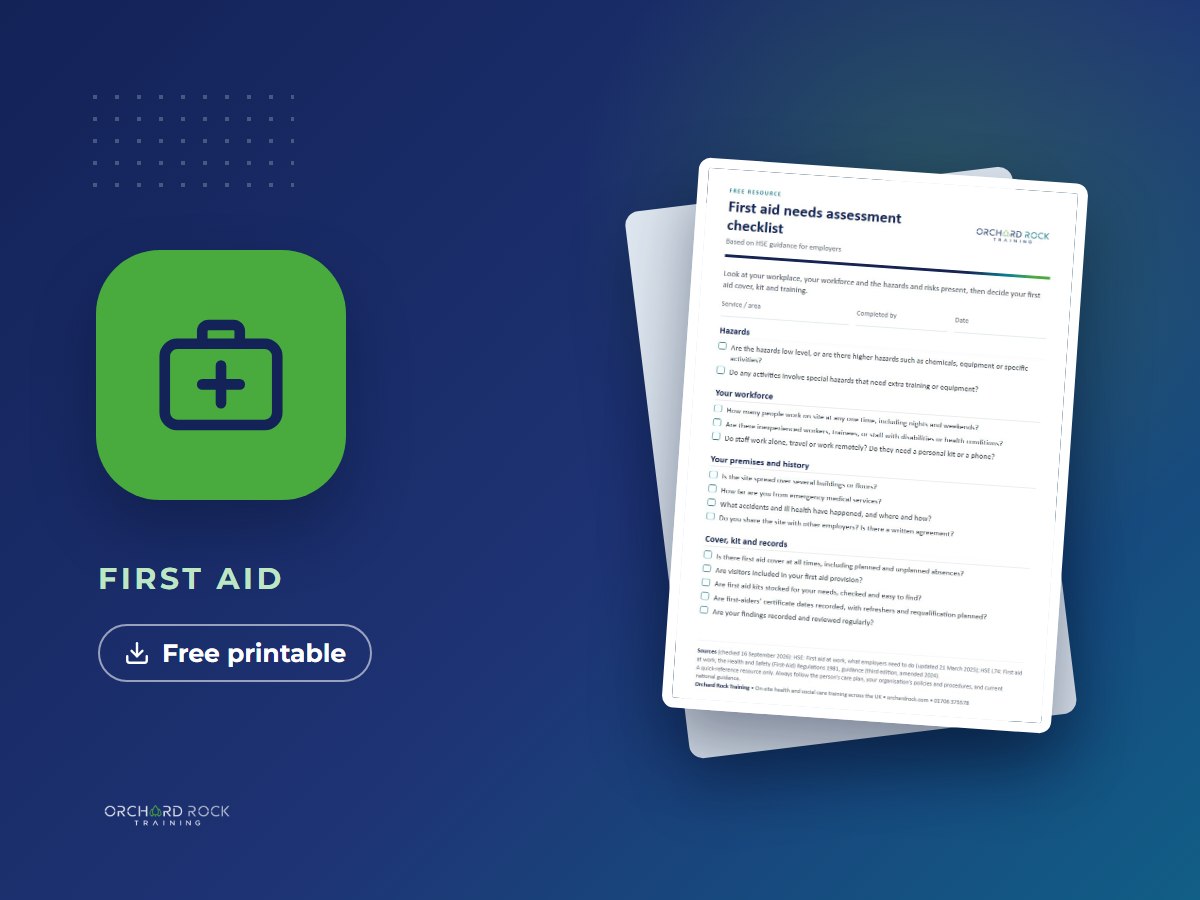
Start with the needs assessment, not the course
The Health and Safety Executive (HSE) asks every employer to assess the first aid needs appropriate to the circumstances of their business. In practice, that means looking at:
- the work you do, and the hazards your risk assessment already found
- the nature and size of your workforce
- work patterns, including shifts, nights, lone workers and people who travel
- holidays and other absences among the people who will be first aiders
- your own record of accidents and ill health, and where incidents happened
- how far you sit from the emergency services, and whether you work across several sites
The regulations do not make you provide first aid for members of the public. However, HSE strongly recommends that employers include them in the assessment and make provision for them anyway. So if you run a shop, a hotel or a visitor centre, count them in.

How many first aiders do you need?
“There are no hard and fast rules on exact numbers,” HSE says. As a guide, though, it suggests the following, based on how hazardous the work is and how many people you employ. Higher-hazard workplaces need more cover.
Low hazard: offices, shops, libraries
- Fewer than 25 employees: at least one appointed person
- 25 to 50 employees: at least one first aider trained in EFAW
- More than 50 employees: at least one first aider trained in FAW for every 100 employed, or part thereof
Higher hazard: warehousing, construction, food processing
- Fewer than 5 employees: at least one appointed person
- 5 to 50 employees: at least one first aider trained in EFAW or FAW, depending on the type of injuries that might occur
- More than 50 employees: at least one first aider trained in FAW for every 50 employed, or part thereof
HSE’s own examples of higher-hazard work are light engineering and assembly work, food processing, warehousing, extensive work with dangerous machinery or sharp instruments, construction and chemical manufacture.
Read the heading on that table carefully, because it changes the maths: these are the numbers to have available at all times people are at work. Therefore one trained first aider rarely covers a workplace on its own, once you allow for shifts, annual leave and sickness.
Appointed person or first aider?
An appointed person takes charge of your first aid arrangements, looks after the equipment and calls the emergency services. They need no first aid training at all. They can also cover a first aider who is away unexpectedly, although HSE is clear that annual leave does not count as unforeseen.
A first aider has done training at the level your assessment identified: FAW, EFAW, or another course appropriate to your workplace.
What each course actually covers
Emergency First Aid at Work (EFAW), one day
HSE expects at least six hours of training and assessment over a minimum of one day. An EFAW first aider gives emergency first aid to someone who is injured or becomes ill at work: an unconscious casualty including seizures, CPR and a defibrillator, choking, bleeding, shock, and minor injuries and burns. For most offices, shops and smaller workplaces, this is the course.
First Aid at Work (FAW), three days
HSE expects at least 18 hours over a minimum of three days. FAW teaches everything EFAW does and then adds specific injuries and illness: bones, muscles and joints including suspected spinal injuries, chest injuries, burns and scalds, eye injuries, sudden poisoning and anaphylaxis. It also covers recognising major illness, such as heart attack, stroke, epilepsy, asthma and diabetes. Higher-hazard sites and larger employers usually need at least one FAW first aider.
First Aid Awareness, half a day
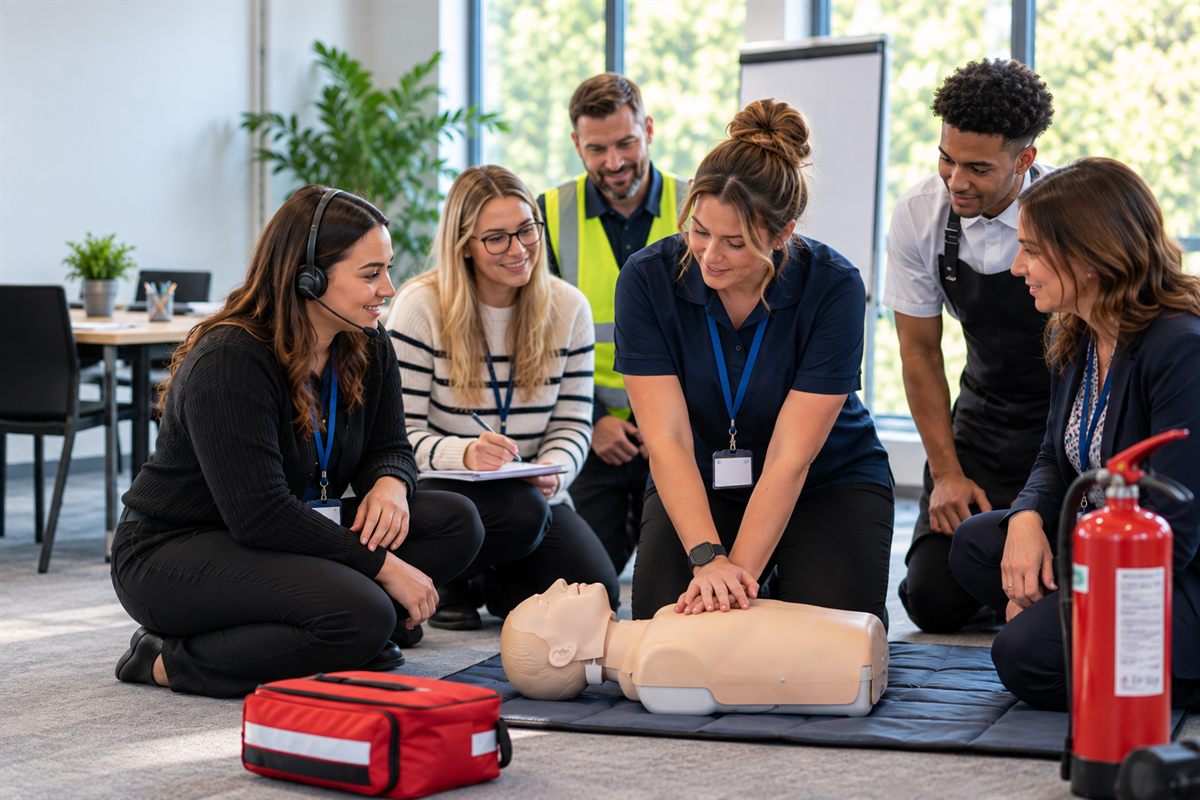
This one sits outside the FAW and EFAW route, so it does not make someone your statutory first aider. Instead, it gives a whole team the basics: the first aider’s role, the primary survey, CPR and defibrillation, the recovery position and the emergencies staff meet most often. Plenty of employers run it across the team alongside a smaller number of qualified first aiders.
Basic Life Support (BLS), half a day
Three hours on the skills that save lives: the primary survey, CPR, using an AED, the recovery position and choking. It works well as a yearly top-up for first aiders, and it is the course care services book most often for wider teams.
Paediatric First Aid, two days
Early years settings follow their own rule. The EYFS statutory framework says at least one person with a current paediatric first aid certificate must be on the premises and available at all times when children are there, and must go with them on outings. Staff renew that certificate every three years.
Certificates, refreshers and requalifying
- FAW and EFAW certificates last three years, and the certificate itself should say so
- book the requalification before the certificate runs out, rather than after
- HSE strongly recommends annual refresher training in between, so first aiders keep their basic skills sharp
- requalifying in FAW takes at least 12 hours over two days; EFAW requalification runs for the same six hours as the original course
Three things employers get wrong
- Treating one first aider as cover. Two people on a rota beats one on paper, because holidays, sickness and night shifts all happen.
- Buying online-only training for hands-on skills. HSE accepts blended learning, which mixes e-learning with face-to-face time. However, it asks you to check that the provider supports learners properly, prevents identity fraud, leaves enough classroom time, and assesses the practical elements by direct observation. HSE also warns that class sizes above 12 make it harder to assess every candidate, which is why we cap practical groups at 12.
- Leaving mental health out of the assessment. HSE suggests employers may decide it is worth having people trained to recognise the warning signs, alongside physical first aid.
Quick answers
- Office with 30 staff: at least one EFAW first aider, and more if you run shifts or several floors
- Warehouse with 60 staff: at least one FAW first aider for every 50 people, so two, plus cover
- Shop or café with 12 staff: an appointed person is the minimum, though many choose EFAW anyway
- Nursery: paediatric first aid, on the premises whenever children are there
- Care service: EFAW or First Aid Awareness across the team, with BLS as the yearly refresher
Still unsure? Send us your staff numbers and tell us what your team does, and we will say which course fits, even when the answer is the cheaper one.
Book the right course
- Emergency First Aid at Work (EFAW) (full day): the emergency skills most workplaces need
- First Aid at Work (FAW) (3 days): the full qualification, with injuries and illness in depth
- First Aid Awareness (half day): the basics for a whole team
- Basic Life Support (BLS) (half day): CPR, AED, recovery position and choking
- Paediatric First Aid (2 days): babies and children, for early years settings
- Mental Health First Aid (2 days): the other side of first aid at work
Free resources
Download, print and share these with your team.
Sources: HSE, First aid at work: your questions answered (INDG214) and Selecting a first-aid training provider (GEIS3); HSE, First aid at work: what employers need to do; GOV.UK, Early years foundation stage statutory framework. Correct as of 23 September 2026.