
Ask three nursery managers what training the EYFS requires and you will get three answers, usually with “I think” in front of them.
The framework is actually quite short on the subject. It names only a few things, but it is precise about those, and the September 2026 version has tightened the detail again around mealtimes. Here is what it says.
Paediatric first aid: the one everybody knows
At least one person with a current paediatric first aid certificate must be on the premises and available at all times when children are present, and must go with children on outings. The certificate must be for a full course, and the training must be renewed every three years.
Two details catch settings out. First, anyone who gained a level 2 or level 3 qualification since 30 June 2016 must get a paediatric first aid certificate within three months of starting work to be counted in the staff-to-child ratios. Second, the framework asks providers to take account of the number of children, the number of staff and the layout of the premises, so that a paediatric first aider can reach an emergency quickly.
In a setting spread over two floors, one certificate rarely covers that. Most nurseries end up training a good proportion of the room staff rather than the minimum.
Safeguarding: the renewal date people miss
All practitioners must be trained in line with the framework’s own criteria, and they must be supported and confident to put the setting’s safeguarding policy into practice. The designated safeguarding lead must attend a training course that meets those criteria too.
Then comes the line worth writing on the wall: safeguarding training must be renewed every two years. The framework also invites providers to consider whether staff need an annual refresher within that two-year period, to keep the basics fresh or after a safeguarding concern in the setting.
So the two dates in your matrix run on different clocks: paediatric first aid every three years, safeguarding every two.

Induction, and what it must contain
Providers must make sure all staff receive induction training covering their roles and responsibilities, and the framework lists what it must include: emergency evacuation procedures, safeguarding, child protection, and health and safety.
That last pair is why fire safety and health and safety end up on nursery training plans even though no course is named. Something has to sit behind “emergency evacuation procedures”, and a fire drill on its own is not training.
The mealtime rules people miss
This is the part that has moved most, and it is worth reading twice:
- while children are eating, there must always be a member of staff in the room with a valid full paediatric first aid certificate
- providers must ensure all staff are aware of the symptoms and treatments for allergies and anaphylaxis, know the difference between an allergy and an intolerance, and understand that children can develop allergies at any time, especially when moving on to solid foods
- food must be prepared in a way that prevents choking, and children must always be within sight and hearing of a member of staff while they eat
- choking can be completely silent, so staff should sit facing children where possible
Read together, those lines do more than a policy ever will. They mean allergy and anaphylaxis awareness is expected across the whole team, not just the person who holds the first aid certificate.
Food, medicines and the rest
- Food hygiene. All staff involved in preparing and handling food must receive training in food hygiene. That covers the key worker making toast, not only the cook
- Medicines. Staff must have training where giving a medicine needs medical or technical knowledge. Buccal midazolam for a child with epilepsy is the usual example
- Supervision. Providers must put arrangements in place for supervising staff who work with children and families, with coaching and training as part of it
What the framework leaves to you
Everything else is your judgement, and this is where nursery staff training either becomes useful or becomes a tick-box exercise. The subjects settings most often add:
- Allergy and anaphylaxis for the whole team, as above
- Autism, ADHD and demand avoidance, usually once a particular child arrives and the team wants to do it properly
- Epilepsy and buccal midazolam, where a child has a care plan for seizures
- Infection control, because a nursery outbreak is a long fortnight for everyone
- Safer recruitment for whoever interviews and takes up references
A simple plan for a small setting
- Everyone: safeguarding (two years), allergy and anaphylaxis awareness, food hygiene if they handle food at all, and induction covering evacuation, child protection and health and safety
- Enough of the team to cover every room and every shift: paediatric first aid (three years)
- The manager and the designated safeguarding lead: a DSL course, plus safer recruitment
- Anyone supporting a specific child: the training that child’s plan needs, arranged before they start rather than after
Because we train on site, most settings put two half days together on a closure day and clear several of those in one go.
Courses for early years settings
- Paediatric First Aid (2 days): the full course the EYFS asks for, babies and children throughout
- Safeguarding Children (half day): recognising and responding to concerns, and your reporting route
- Anaphylaxis (half day): symptoms, auto-injectors and what to do first
- Food Safety (half day): food hygiene for everyone who prepares or handles food
- Fire Safety (half day): what sits behind your evacuation procedure
- Autism Awareness (half day) and ADHD Awareness (half day): understanding the children in front of you
- Epilepsy & Buccal (full day): seizures and administering buccal midazolam
- Safer Recruitment (half day): for whoever hires
More for schools, colleges and early years settings is on our training for schools and early years page. Send us your team list and we will tell you what the framework requires and what is optional.
Free resources
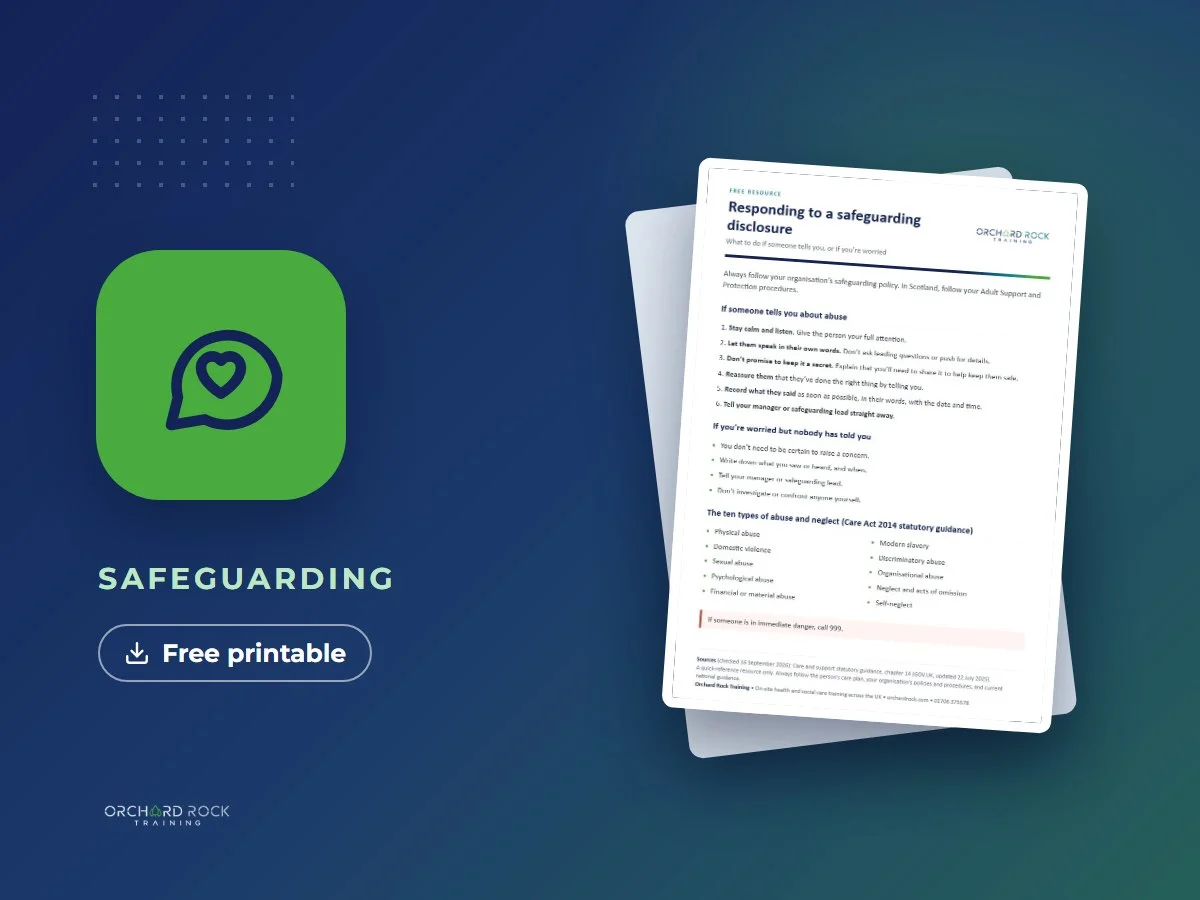
Download, print and share these with your team.
Source: Department for Education, Early years foundation stage statutory framework for group and school-based providers, in force from 1 September 2026 (paragraphs 3.31 to 3.39, 3.61, 3.64 to 3.72). Correct as of 23 September 2026.