
The short version
- Every care worker needs seven subjects: health and safety, fire safety, moving and handling objects, infection prevention and control, adult safeguarding, child safeguarding, and learning disability and autism awareness.
- Four more depend on the role: basic life support and first aid, assisting and moving people, food hygiene, and medication.
- Sector guidance sets three years as the minimum refresher for most subjects, but basic life support is yearly and medicines competency is reviewed every year.
- The legal duty sits in CQC Regulation 18: staff must get the training they need for the job they do.
This guide covers adult social care in England. Scotland and Wales have their own regulators and frameworks.
The legal duty: CQC Regulation 18
Regulation 18 of the Health and Social Care Act 2008 (Regulated Activities) Regulations 2014 says staff must “receive such appropriate support, training, professional development, supervision and appraisal as is necessary to enable them to carry out the duties they are employed to perform”.
CQC’s guidance on the regulation adds the practical detail. Providers must have an induction programme that prepares staff for their role. Each person’s training needs are looked at when they start, then reviewed at appropriate intervals. Where appropriate, staff are supervised until they can show they are competent to work on their own. CQC also says this includes first aid training for people working in adult social care.
Statutory or mandatory: what is the difference?
Sector guidance for adult social care employers, last updated in December 2025, separates the two. Statutory training is usually required by law, or by a statutory body acting on specific legislation. Mandatory training is what an organisation, or the people who commission its services, decide is essential for safe and efficient care.
CQC expects staff to take part in both: statutory training, and the other mandatory training you define for each role.
Training every care worker needs
The same guidance lists seven subjects as required for all workers:
- Health and safety awareness
- Fire safety
- Moving and handling objects
- Infection prevention and control
- Adult safeguarding
- Child safeguarding
- Learning disability and autism awareness
Child safeguarding is on that list for every worker, including in services for adults.
Training that depends on the role
Four more subjects depend on what each person does:
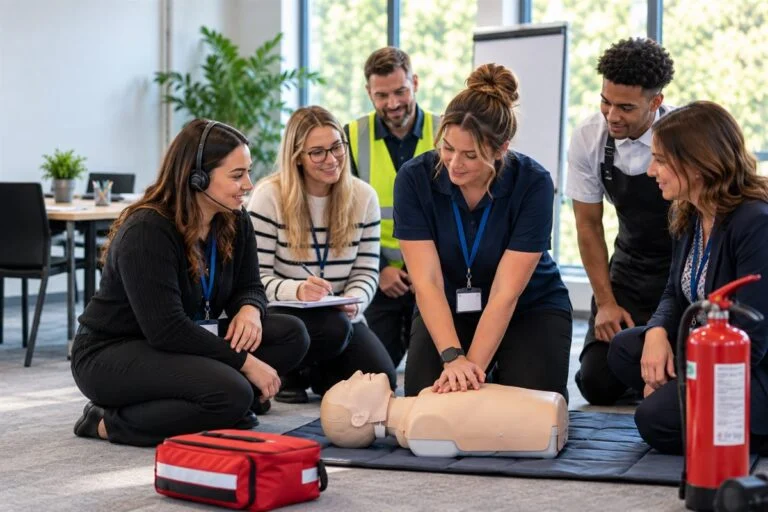
Basic life support and first aid
It is the employer’s responsibility to decide how many people need training, and to what level.
Assisting and moving people
For anyone who helps people to stand, transfer or reposition. HSE says handling aids help people move safely when appropriately trained carers use them.
Food hygiene
Food handlers must be supervised and instructed or trained in food hygiene to match their work. The Food Standards Agency says to train them, including on allergens, before they start. A certificate is not a legal requirement, but you must be able to show the training.
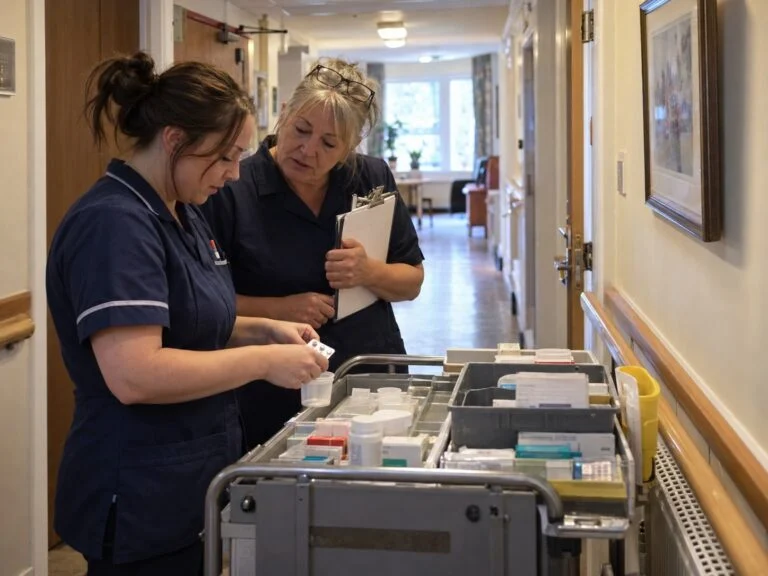
Medication
Anyone who supports people with medicines needs training. NICE says care home staff should give medicines only once they are trained and assessed as competent.
How often to refresh
That guidance sets a minimum refresher period for each subject. Treat these as the floor, not the target:
- Health and safety, fire safety, moving and handling objects, infection prevention and control, adult safeguarding: at least every three years, and sooner when a new risk or activity is introduced. A recognised adult social care qualification that covers the topic restarts the three years.
- Child safeguarding, and assisting and moving people: at least every three years.
- Food hygiene: every three years.
- Basic life support: at least once a year.
- First aid: every three years. HSE says first aid certificates last three years, and it strongly recommends a yearly refresher in between, although that refresher is not mandatory.
- Medication: review training needs and competency after a year. NICE asks for a yearly review of medicines knowledge, skills and competency, both in care homes and in home care.
- Learning disability and autism: at least every three years, under the Oliver McGowan code.
The guidance also says fire drills should be held at least once a year, and that employers must check and evidence that staff stay competent. You can, of course, refresh more often than the minimum. Each of our course pages gives the period we recommend for that course.
Worth remembering
A certificate shows that someone attended. What CQC wants to see is staff who are competent in the job they do.
Learning disability and autism: a duty in its own right
Since 1 July 2022, the Health and Care Act 2022 has required every CQC-registered provider to make sure its staff receive training on learning disability and autism that is appropriate to their role. The Oliver McGowan code of practice, which explains how to meet that duty, became final on 6 September 2025.
The government’s preferred and recommended package is the Oliver McGowan Mandatory Training. It comes in two tiers. Tier 1 is 90 minutes of e-learning plus a one-hour online interactive session. Tier 2 is the same e-learning plus a one-day face-to-face session.
According to the code, care home staff are likely to need Tier 2, while staff who do not meet the public, such as laundry or garden staff, may only need Tier 1. In a home care agency, staff who have contact with the public are likely to need Tier 2.
To be clear about our own courses: Autism Awareness and Learning Disabilities build understanding across a team, but they are not the Oliver McGowan Mandatory Training, and they do not replace it.
The Care Certificate and induction
The Care Certificate standards were updated in March 2025, and there are now 16. The new Standard 16 covers awareness of learning disability and autism. The standards are designed to shape induction for people who are new to care.
The code of practice on preventing and controlling infections makes the same link. It expects new health and social care workers to complete competency training, for example the Care Certificate, as part of induction. It also asks the registered manager to keep a record of all induction and ongoing training.
What inspectors look for
CQC’s quality statement on safe and effective staffing puts it in one line: “Staff receive training appropriate and relevant to their role.” Its Regulation 18 guidance adds that training should be monitored, with action taken quickly when it falls behind. In practice, that means being able to show:
- a training matrix with every subject, every person and every due date
- induction records, including the Care Certificate for new starters
- evidence of competency checks, such as an observed medicines round
- a plan for anything that is overdue
Book the training
- Health and Safety (half day)
- Fire Safety (half day)
- Moving and Handling (full day): people and objects, using your own equipment
- Infection Control (half day)
- Safeguarding Adults at Risk (half day)
- Safeguarding Children (half day)
- Basic Life Support (half day)
- Food Safety (half day)
- Medication Administration (full day)
All of these run on-site at your service, so the training fits your building, your equipment and the people you support.
Free resources
Download, print and share these with your team.
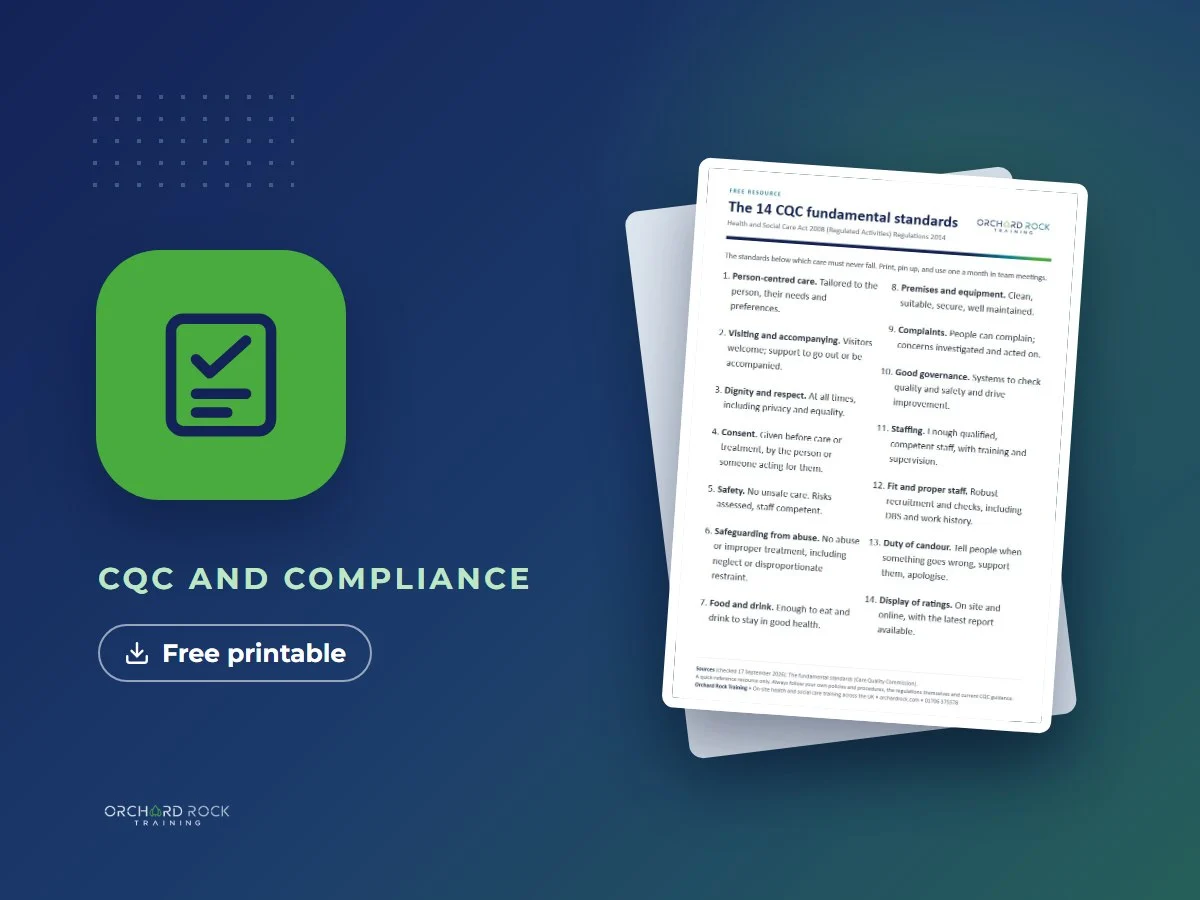 Free resourceCQC fundamental standards posterThe 14 standards every care service must meet, in plain English, on one printable page.
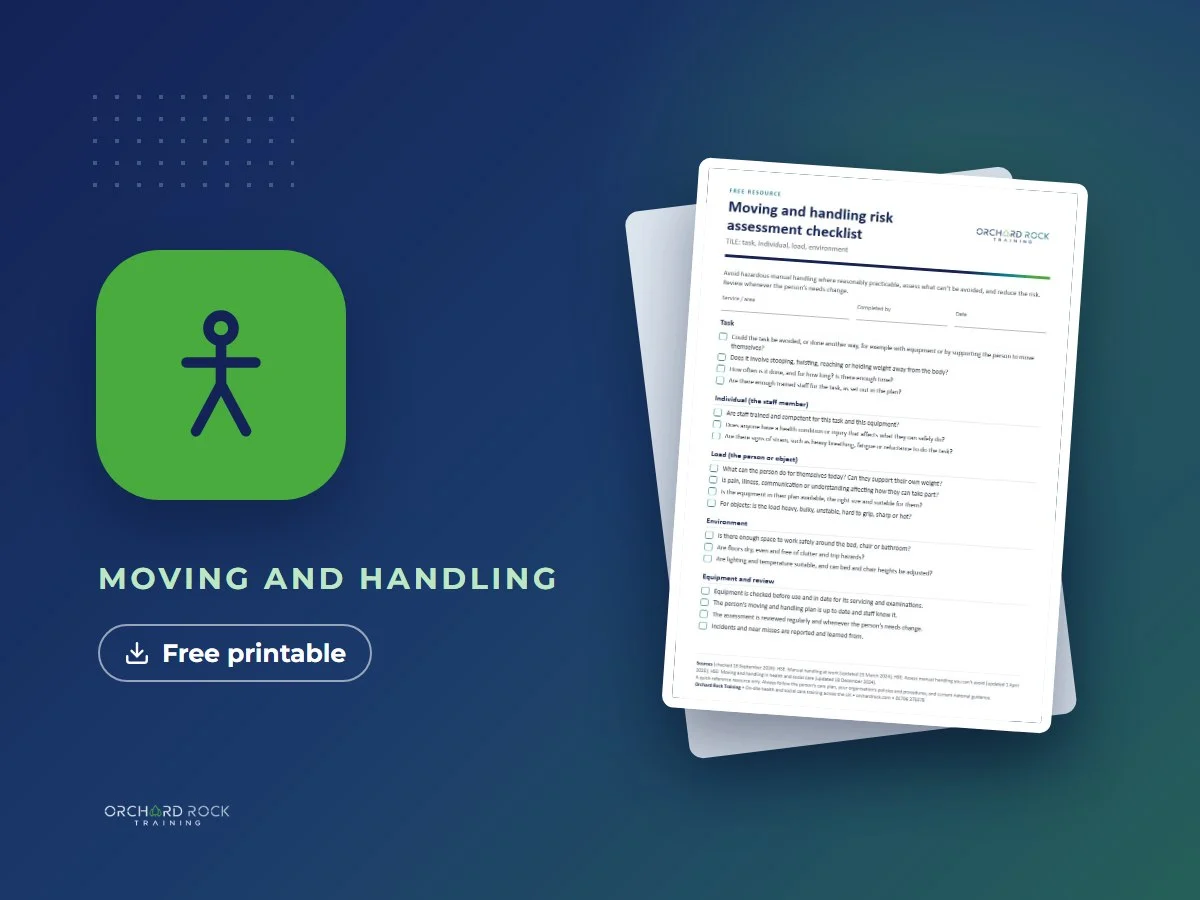 Free resourceMoving and handling risk assessment checklistA printable TILE checklist for care teams: the task, the individual, the load and the environment, plus people handling prompts.
Sources: legislation.gov.uk, Regulation 18, Staffing and Health and Care Act 2022, section 181; CQC, Regulation 18: Staffing and Safe and effective staffing; GOV.UK, The Oliver McGowan code of practice and Code of practice on the prevention and control of infections; NICE, Managing medicines in care homes (SC1) and Managing medicines for adults receiving social care in the community (NG67); HSE, Moving and handling equipment and Are you a first-aider?; Food Standards Agency, Managing food safety. Correct as of 21 October 2026.